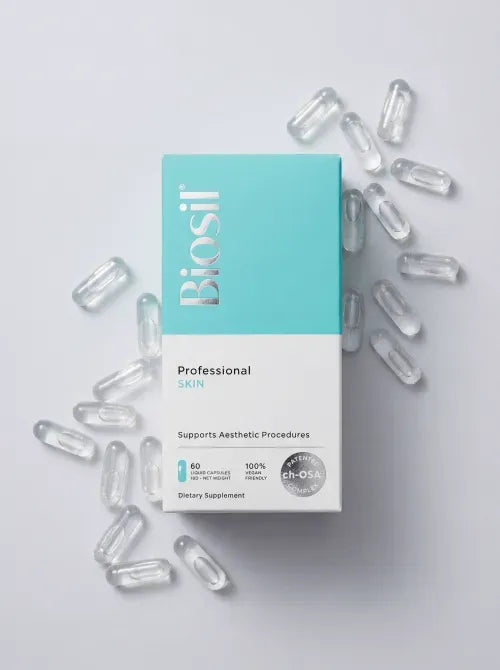
What is ch-OSA®?
ch-OSA® (choline-stabilized orthosilicic acid) is a patented, highly bioavailable form of silicon. Silicon reaches the body in a usable state only as orthosilicic acid, and orthosilicic acid on its own is unstable: in water it quickly clumps together (polymerizes) into larger particles the body cannot absorb. Biosil® uses choline to stabilize the molecule, which keeps the silicon soluble, concentrated, and bioavailable. That stabilized complex is what ch-OSA® means. You may also see it written as chOSA or CSOA (choline-stabilized orthosilicic acid).
In short, ch-OSA® is not collagen and it is not a drug. It is a silicon supplement designed to deliver silicon in the one form the body can readily use, so the body has the raw material it uses in its own collagen formation. Silicon as ch-OSA® is a food supplement and an adjunct to a balanced diet, not a replacement for clinical care.
How ch-OSA® Works: Generate vs. Ingest
Most collagen products ask you to ingest collagen: you swallow hydrolyzed collagen protein and hope the amino acids are routed back to the tissues you care about. ch-OSA® takes the other route. It is designed to help your body generate its own collagen by supplying bioavailable silicon, a cofactor the body is thought to use when it builds and cross-links collagen.
The mechanism is best described as translational and hypothesized rather than fully settled human physiology, so it should be read as thought to support, not as a proven action. Silicon is associated with the enzymes involved in collagen formation and maturation (including prolyl hydroxylase, lysyl hydroxylase, and lysyl oxidase) and with ornithine aminotransferase. Because bone is roughly 30% collagen by tissue, and that collagen matrix is the scaffold minerals attach to, supporting the body's own collagen formation is a reasonable, general nutritional angle for skin, hair, nails, bone, and connective tissue.
What this does not mean: ch-OSA® does not treat, cure, heal, or speed up healing of any tissue on its own, and it should always be discussed with your treating clinician before use.
The Evidence: What ch-OSA® Does, and Does Not, Show
Honest positioning matters more than hype here, so each study is stated with its caveat. The pattern across the research is consistent: ch-OSA® is associated with markers of collagen formation, while the harder clinical endpoints are either small, preliminary, or not yet demonstrated.
Bone: Spector et al. 2008
A 12-month randomized, placebo-controlled trial in osteopenic women found that ch-OSA® added to calcium and vitamin D3 was associated with a higher level of PINP (a marker of bone collagen formation), on the order of 15%. This is a marker of collagen-building activity, not a fracture or density outcome: the change in hip bone mineral density was a small, non-significant trend and should not be read as a proven benefit. The population was osteopenic women taking a calcium and vitamin D3 co-intervention, not surgical or dental patients.
Skin, Hair, and Nails: Barel and Wickett
Skin and hair studies (Barel et al. 2005 on skin, nails, and hair in women with photodamaged skin, and Wickett et al. 2007 on hair tensile strength) reported improvements in skin surface, mechanical properties, and hair strength with oral ch-OSA®. These sit here as supporting context and as a transposition: skin and gingiva share collagen types I and III, so the biology is related, but a skin or hair result is not proof of a dental or bone result.
Joints
Interest in silicon and joint health exists, but the joint evidence for ch-OSA® is limited and exploratory. It is mentioned here for completeness, not as a claim.
Dental: Teughels et al. 2021
The only direct dental evidence is Teughels et al. 2021, a small, exploratory, double-blind, placebo-controlled study of ch-OSA® in patients with peri-implant conditions. It should be read as preliminary. Importantly, it did not show that ch-OSA® reduces bleeding, pocket depth, or bone loss. Any dental relevance is therefore reasoned from shared collagen biology, not proven for a specific procedure or outcome.
What ch-OSA® Does Not Show
A fair reading of the literature also means naming the limits plainly. Independent commentators have rightly pointed out that some marketing claims for silicon supplements run ahead of the data, and we agree with that caution.
- ch-OSA® is not a drug. It does not treat, cure, heal, or prevent any disease or complication.
- It has not been shown to speed up wound healing, prevent dry socket, improve osseointegration at an implant surface, or reduce surgical complications.
- The bone-marker and cell-culture findings show collagen-building activity; they do not prove a clinical outcome for any specific procedure.
- The mechanism is reasoned from collagen biology and is best treated as an adjunct to nutrition, not as a therapy.
Distinguishing what is proven (the markers) from what is reasoned (applying it to a procedure) is the honest way to talk about ch-OSA®, and it is how Biosil® frames it.
ch-OSA® vs. Collagen Peptides
These are two different tools, not better-or-worse versions of the same thing. One supplies collagen to ingest; the other supplies a cofactor the body uses to generate its own.
ch-OSA® compared with collagen peptides: what each is and how it is thought to work
| Feature |
ch-OSA® (choline-stabilized orthosilicic acid) |
Collagen peptides |
| What it is |
Bioavailable silicon, a cofactor involved in collagen formation |
Hydrolyzed collagen protein (amino acids and peptides) |
| Core idea |
Helps the body generate its own collagen |
Supplies collagen for the body to ingest |
| Typical dose |
Micrograms of elemental silicon (a low-dose cofactor) |
Grams of protein per serving |
| Source and supply |
Patented, single manufacturer (Bio Minerals NV) |
Commodity ingredient from many suppliers |
| Evidence type |
Bone-marker RCT, in-vitro collagen synthesis, exploratory dental trial |
Skin and joint trials on ingested collagen |
| Regulatory status |
Dietary supplement; silicon holds FDA GRAS status |
Dietary supplement (food protein) |
Neither is a medicine, and the two are not mutually exclusive. The right choice depends on your goals and your clinician's advice.
Is ch-OSA® Safe?
ch-OSA® has a long, reassuring safety record. Silicon holds FDA GRAS (Generally Recognized As Safe) status, the European Food Safety Authority issued positive opinions on ch-OSA® (2009 and 2011), and the ingredient has more than 30 years of use with no serious adverse effects reported at supplement levels. Silicon is also a normal part of the diet, found in whole grains, vegetables, and drinking water.
As with any supplement, ch-OSA® is an adjunct and never a replacement for clinical care. If you are pregnant, breastfeeding, taking medication, or recovering from a procedure, discuss any supplement with your treating clinician before starting.
Who Makes ch-OSA®? Bio Minerals NV and the Patent
ch-OSA® is developed and manufactured by Bio Minerals NV, a company based in Belgium. Bio Minerals NV holds United States patent 7,968,528 covering the choline-stabilized orthosilicic acid complex, the innovation that keeps orthosilicic acid stable and bioavailable rather than letting it gel. Because of that patent and its manufacturing process, Bio Minerals NV is effectively the single source of the ch-OSA® molecule used in Biosil® supplements.
Biosil® is the consumer brand built on that molecule. Biosil® Health (biosil.health) serves practitioners and clinical or post-procedure audiences, while Biosil® Beauty (biosil.beauty) covers hair, skin, and nail use. Same molecule, same manufacturer, one entity.
ch-OSA® in a Clinical and Post-Procedure Context
Most public information about ch-OSA® sits in the beauty and bone space. The clinical and post-procedure angle is where the collagen-generation story is most relevant to practitioners, so this is the context Biosil® Health focuses on. The framing is deliberately conservative: ch-OSA® supports the body's general collagen and bone nutrition. It is not tied to a specific surgical site, it does not act at an implant surface, and it is an adjunct to clinical care, never a substitute for it.
For readers researching a specific recovery, these guides go deeper on the clinical picture, with ch-OSA® kept in its proper place as general background nutrition:
The same collagen-generation rationale extends to dermatology and aesthetic recovery contexts, where skin is collagen-rich. Dedicated Biosil® Health resources for those areas are in preparation. In every case, ch-OSA® is discussed as an adjunct, and any supplement should be reviewed with your treating clinician.
Work With Biosil® Health
Biosil® Health supports two audiences building on the same ch-OSA® science.
For practitioners
Dental, dermatology, and aesthetic practitioners can access the evidence library, patient-facing explanations, and a practitioner program to recommend ch-OSA® as an adjunct to their protocols. Request practitioner access.
For distributors and partners
Distributors, clinics, and trade partners looking to carry Biosil® can apply for wholesale and partnership terms. Become a Biosil® partner.
Sources
- Spector TD, et al. Choline-stabilized orthosilicic acid supplementation as an adjunct to calcium/vitamin D3 stimulates markers of bone formation in osteopenic females: a randomized, placebo-controlled trial. BMC Musculoskelet Disord. 2008;9:85. View source
- Teughels W, et al. The effect of choline-stabilized orthosilicic acid in patients with peri-implantitis: an exploratory randomized, double-blind, placebo-controlled study. BMC Oral Health. 2021. View source
- Reffitt DM, et al. Orthosilicic acid stimulates collagen type 1 synthesis and osteoblastic differentiation in human osteoblast-like cells in vitro (cell-culture study, not human or implant). Bone. 2003. View source
- Barel A, et al. Effect of oral intake of choline-stabilized orthosilicic acid on skin, nails and hair in women with photodamaged skin. Arch Dermatol Res. 2005. View source
- Wickett RR, et al. Effect of oral intake of choline-stabilized orthosilicic acid on hair tensile strength and morphology in women with fine hair. Arch Dermatol Res. 2007. View source
- Bio Minerals NV. Choline-silicic acid complex with osmolytes and divalent trace elements (US Patent 7,968,528 B2). View source
- Orthosilicic acid, PubChem CID 14942 (National Library of Medicine). View source