Collagen Supplements for Nails: The Honest Answer
Search "collagen supplements for nails" and you get a wall of confident promises. The biology is more useful than the marketing. Your visible nail plate is made of keratin, a hard protein, not collagen. A collagen supplement does not become your nail. What collagen actually builds is the connective tissue of the nail bed and the matrix your nail grows out of, plus the skin around it. That is where nutrition can play a supporting role.
This guide separates what the evidence supports from what the labels imply. It covers whether ingested collagen helps nails, what genuinely makes nails brittle, what dermatologists say actually strengthens them, and where silicon (the angle behind Biosil® and ch-OSA®) fits as general collagen nutrition.
Are nails collagen or keratin?
The nail plate is keratin. Underneath and around it, the nail matrix (where growth begins), the nail bed, and the surrounding dermis are rich in collagen, mostly types I and III. Silicon is present in nails at roughly 1 to 10 parts per million, and it is a cofactor your body uses when it forms collagen. So the collagen story for nails is about the foundation the nail grows from, not the plate itself. Keep that distinction in mind whenever a product suggests collagen simply becomes stronger nails.
Do collagen supplements actually work for nails?
The honest read: the direct evidence is thin and mostly short, small, and industry funded. The most cited nail trial (Hexsel 2017) gave 25 people a specific bioactive collagen peptide for 24 weeks and reported a 12% faster nail growth rate and 42% fewer broken nails. Encouraging, but it was open label with no placebo group, so expectation and season can influence the result. Bottom line: ingested collagen peptides may help some people with brittle nails at the margins, but they are not a guaranteed fix, and a nail takes months to grow out, so any change is slow.
What Actually Makes Nails Brittle
Most brittle-nail cases are not a collagen deficiency at all. They trace back to everyday wear and, less often, an underlying health issue.
Everyday causes you can change
-
Repeated wet-to-dry cycles: frequent hand washing, dishes, and swimming swell then shrink the nail, splitting the layers.
-
Harsh chemicals: acetone removers, cleaning solvents, and some gel or acrylic routines dry and weaken the plate.
-
Over-manicuring: aggressive filing, cuticle cutting, and picking damage the nail and its seal.
-
Low humidity and age: nails hold less moisture as you get older and in dry climates, so they crack more easily.
Health-related causes worth a check
Persistent brittleness, especially alongside other symptoms, can point to iron deficiency, thyroid problems, or a skin condition affecting the nail. Certain medications matter too. If your nails changed suddenly, are spooning, discoloring, or lifting, that is a reason to see a clinician rather than reach for another supplement. Appearance changes are a signal, not something to self-treat blindly.
What Genuinely Helps Weak Nails
Dermatology basics beat most supplements here, and they are cheap. Use the table below to prioritize.
Approaches to stronger nails, ranked by how well they are supported
| Approach |
How it may help |
Evidence strength |
| Protect from water and chemicals (gloves, less acetone) |
Stops the split-and-dry cycle at the source |
Strong, first line |
| Moisturize nails and cuticles daily |
Keeps the plate flexible so it bends rather than snaps |
Strong |
| Adequate dietary protein, iron, and overall nutrition |
Supplies the raw material for keratin and the collagen bed |
Moderate, foundational |
| Biotin supplement |
May help genuinely brittle nails in some studies |
Limited, mixed |
| Ingested collagen peptides |
Small trials suggest faster growth and fewer breaks |
Limited, short trials |
| Silicon as ch-OSA® (Biosil®) |
Supports the body's own collagen formation generally |
Supportive, appearance |
Nutrition, not just supplements
Before buying anything, cover the basics: enough protein, iron if you are low, and a varied diet. Supplements are an add-on to that foundation, not a substitute for it. If a specific deficiency is driving your brittle nails, correcting that deficiency does far more than any beauty capsule.
The Silicon Angle: ch-OSA® and the Collagen Your Nails Grow From
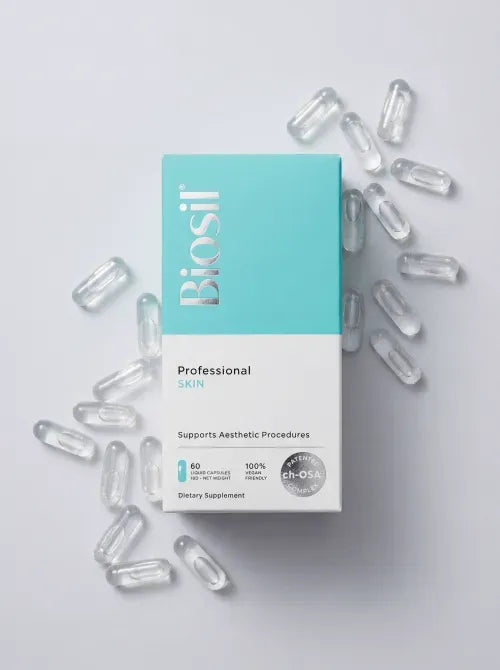
This is where Biosil® sits, and it is a different mechanism from swallowing collagen. Biosil® provides ch-OSA® (choline-stabilized orthosilicic acid), a highly bioavailable form of silicon. The idea is not to add collagen to your body, but to give your body a cofactor it uses to generate its own. Because the nail matrix and bed are set in collagen-rich tissue, supporting that collagen is the plausible route to firmer-looking nails.
What the silicon and nail evidence actually shows, and its limits
| Study |
Design |
What it found |
Caveat |
| Barel 2005 |
Randomized, placebo-controlled, 50 women, 20 weeks, 10 mg Si/day as ch-OSA® |
Self-reported nail brittleness dropped significantly with ch-OSA®, not with placebo |
Subjective rating, manufacturer funded |
| Chandrashekar 2020 |
Open label, single arm, 5 months, ch-OSA® |
Fewer broken nails and smoother nails over the study |
No control group, visual only, industry funded |
| Reffitt 2003 |
Cell culture (in vitro), human cells |
Orthosilicic acid stimulated collagen type 1 synthesis |
Not human, not nails, mechanism only |
Read together, these point to a reasonable structure-and-function story: silicon supports the collagen your body makes, and that may show up as less brittle, better-looking nails over months. It is not proof that a supplement rebuilds nails, and the strongest data here is manufacturer funded, which is worth naming plainly. New to the molecule? See what ch-OSA® is, or read how we handle the science on our peer-review page. The same collagen biology underlies skin questions like how to get rid of acne scars, and it all sits under our dermatology range.
Where ch-OSA® fits: your nails grow from collagen-rich tissue, and silicon is a cofactor your body uses to build that collagen. ch-OSA® from Biosil® supports your body's own collagen formation generally. It is an adjunct to good nail care, so discuss any supplement with your clinician.
When to See a Doctor About Your Nails
See a clinician if your nails suddenly change shape, color, or thickness, if they lift from the bed, if brittleness comes with fatigue or hair loss, or if consistent home care over a few months changes nothing. Nails can reflect general health, so a persistent problem deserves a real diagnosis rather than another capsule.
Sources
- Barel A, et al. Effect of oral intake of choline-stabilized orthosilicic acid on skin, nails and hair in women with photodamaged skin. Arch Dermatol Res. 2005. View source
- Hexsel D, et al. Oral supplementation with specific bioactive collagen peptides improves nail growth and reduces symptoms of brittle nails. J Cosmet Dermatol. 2017. View source
- Reffitt DM, et al. Orthosilicic acid stimulates collagen type 1 synthesis and osteoblastic differentiation in human osteoblast-like cells in vitro (cell-culture study, not human or nails). Bone. 2003. View source
- Chandrashekar BS, et al. Assessment of anti-ageing effects of oral choline-stabilized orthosilicic acid on hair, skin and nails: an open-label study. Int J Res Dermatol. 2020. View source