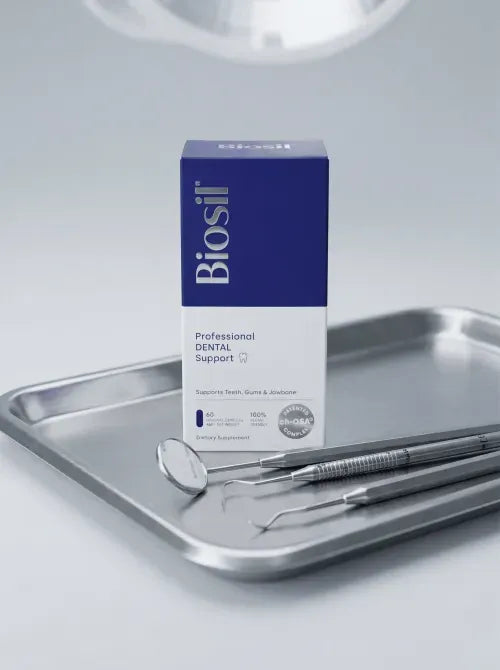
Collagen support in dental and implant care
How collagen biology shapes healing after extractions, grafts and implants, and where ch-OSA® fits. A practical hub for practitioners and patients.

Dental

Why Collagen Decides How Your Mouth Heals
The mouth is a collagen organ. Gum tissue, the periodontal ligament that suspends each tooth in its socket, the connective attachment around an implant, and the organic framework of the jawbone itself are all built from collagen. Enamel is the exception. Everything holding a tooth in place is not.
That is why collagen turns up in every dental healing conversation. An extraction socket, a bone graft, a gum graft and an implant all begin the same way: the body lays down a collagen scaffold, and only then mineralises or matures it. Nothing in the sequence starts until that scaffold exists.

Two facts frame everything below. Collagen networks are rebuilt continuously, which means the body has to manufacture roughly a kilo of new collagen every ten days simply to maintain what it already has. And bone is not just mineral: its collagen matrix is what calcium binds to, so the density of that matrix sets how much mineral can be laid down.

Where ch-OSA® fits, and where it does not
Biosil® does not supply collagen. It supplies ch-OSA® (choline-stabilized orthosilicic acid), a bioavailable form of silicon that acts as a cofactor in the enzyme chain the body uses to build and cross-link its own collagen. That is a nutritional role. It does not treat, cure or prevent periodontitis, peri-implantitis or any other condition, it does not replace scaling and root planing, surgery or implant maintenance, and it is not a reason to delay seeing a dentist. New to the molecule? Start with what ch-OSA® actually is.
The Enzyme Chain Behind Every Collagen Fibre
Collagen is assembled in steps, and each step has an enzyme that can become the bottleneck. Ornithine aminotransferase supplies proline. Prolyl hydroxylases convert proline into hydroxyproline, without which the triple helix cannot form. Lysyl hydroxylases prepare the cross-links. Lysyl oxidase then forms them, first between helices to make fibrils, then between fibrils to make fibres. Cross-linking is what converts a soft scaffold into load-bearing tissue.

Alongside generation there is protection. Homocysteine interferes with collagen cross-linking, and the choline in the ch-OSA® complex contributes to normal homocysteine metabolism, which is one of the few claims here that carries an EFSA-approved wording. Generate and protect, two actions from one molecule, is the whole Biosil® proposition in a sentence.
What the Dental Trials Actually Show
There are two randomised, double-blind, placebo-controlled dental trials of ch-OSA®, both led by Prof. Wim Teughels (Periodontology, KU Leuven University Hospital) with Prof. Cenk Haytac (Periodontology, Cukurova University, Adana). They looked at two different problems and they do not say the same thing, so they are worth separating carefully.
Periodontitis

85 patients with periodontitis were randomised (placebo n=43, ch-OSA® n=42), and 72 completed. All had full-mouth disinfection at inclusion, then took one capsule twice daily for six months. The measured endpoints were probing pocket depth (PPD), bleeding on probing (BOP) and recession.

The shape of this chart is the finding. Both groups improve at three months, which is what full-mouth disinfection does. The difference appears between month three and month six, where the placebo group loses most of its gain and the ch-OSA® group does not. Bleeding on probing follows the same pattern.

In the deepest pockets, the sub-group with good oral hygiene reached a pocket depth of 5.78 mm on ch-OSA® against 7.02 mm on placebo at six months (p<0.05). The authors' own conclusion is measured: the compound may have a preventive action against the development of periodontitis and associated tooth loss.
The caveat that matters. This trial was presented at the Greater New York Dental Meeting. It is a conference communication, not a peer-reviewed indexed publication, and it should be described that way. It was also supported by the manufacturer of the ingredient.
Peri-implantitis

The second trial is smaller and explicitly exploratory: 21 patients randomised, 18 analysed, 36 implants, followed for twelve months after flap surgery, with bone measured on cone beam CT. It is published in BMC Oral Health (2021).


Read this next line before quoting the trial. In this study probing pocket depth and bleeding on probing showed no difference between groups. What separated them was soft tissue recession and the stabilisation of bone loss. That reservation belongs to the peri-implantitis trial and does not transfer to the periodontitis one, where PPD and BOP were exactly the measures that moved. Confusing the two is the most common error made with this evidence.
Bone: the third trial, and the only one indexed
Bone is about 30% collagen, so the bone evidence is directly relevant to grafting and to implant osseointegration even though it was not a dental study. Spector et al. ran a randomised, placebo-controlled trial in 136 of 184 osteopenic women over twelve months, taking 1,000 mg calcium and 800 IU vitamin D3 with or without ch-OSA®, and measured bone turnover markers and bone mineral density. It is published in BMC Musculoskeletal Disorders (2008).

Note what this trial measures: a marker of bone collagen formation, which is the matrix, not the mineral. Bone mineral density at the hip moved by about 2%. It is a real, published, controlled result, and it is about the scaffold rather than about teeth.
The dental evidence in one table
| Study | Design | Population | What moved | Status |
|---|---|---|---|---|
| Teughels, Persyn, Haytac, periodontitis | Randomised, double-blind, placebo-controlled, 6 months | 85 randomised, 72 completed, severe generalised periodontitis | Probing pocket depth and bleeding on probing, both significant at 6 months | Conference communication, Greater New York Dental Meeting |
| Teughels et al., peri-implantitis | Randomised, double-blind, placebo-controlled, exploratory, 12 months | 21 randomised, 18 analysed, 36 implants | Mucosal recession and bone stabilisation on CBCT. No difference in PPD or BOP | Published, BMC Oral Health 2021 |
| Spector et al., bone | Randomised, placebo-controlled, 12 months | 136 of 184 osteopenic women | PINP bone collagen formation marker, and hip bone mineral density | Published, BMC Musculoskeletal Disorders 2008 |
The honest summary. Three controlled trials, all supported by the manufacturer of the ingredient, two of them small, one of them a conference communication rather than an indexed paper. They are consistent with a nutritional role in collagen-dependent healing, and they are not proof that a supplement treats gum disease or saves an implant. Anyone telling you otherwise is going further than the data. We keep the studies, their funding and their limits in plain sight on the peer review page.
Where This Fits in Practice

Periodontitis and peri-implantitis are destructive inflammatory diseases that end in recession, bone loss and tooth or implant loss. Around 796 million people were living with severe periodontitis globally in 2017, and roughly one implant patient in five develops peri-implantitis five to ten years after placement, with no consensus treatment. That is the gap a nutritional adjunct is aimed at, and framing it as an adjunct is not modesty, it is accuracy.
- It does not replace the procedure. Debridement, surgery and maintenance do the work. Nutrition sits underneath them.
- Timescales are biological. The periodontitis trial ran six months and the peri-implantitis trial twelve, because that is how long collagen remodeling and bone maturation take.
- Who should not take it. People with kidney failure or on dialysis are generally advised against silicon-containing supplements. Discuss any supplement with your dentist and your doctor.
- Regulatory status. ch-OSA® is a dietary supplement ingredient. Its safety and bioavailability were assessed by EFSA in 2009.
Explore the Dental Guides
Three in-depth guides sit under this hub, each following one procedure through its real healing timeline.
- Dental implant healing stages: an implant is not a single event but a sequence of biological steps unfolding over several months.
- Gum graft recovery timeline: what a graft to cover exposed roots involves, and what recovery actually looks like week by week.
- Dental bone graft healing stages: three to six months for a typical graft, six to nine for larger ridge grafts and sinus lifts.
Related Biosil® Hubs
The same collagen principle applies to other tissues. For skin, hair and nails, see the dermatology hub, which carries the full map of those trials. For aesthetic procedures and recovery, see the aesthetic hub.
Sources
- Teughels W, Persyn S, Haytac MC. The effect of choline-stabilized orthosilicic acid on periodontitis: a randomized, double-blind, placebo-controlled study. Presented at the Greater New York Dental Meeting (manufacturer-supported).
- Teughels W, et al. The effect of choline-stabilized orthosilicic acid in patients with peri-implantitis: an exploratory randomized, double-blind, placebo-controlled study. BMC Oral Health. 2021;21:485. View source
- Spector TD, et al. Choline-stabilized orthosilicic acid supplementation as an adjunct to calcium and vitamin D3 stimulates markers of bone formation in osteopenic females: a randomized, placebo-controlled trial. BMC Musculoskeletal Disorders. 2008;9:85. View source
- Reffitt DM, et al. Orthosilicic acid stimulates collagen type 1 synthesis and osteoblastic differentiation in human osteoblast-like cells in vitro. Bone. 2003. View source
- Calomme MR, Vanden Berghe DA. Silicon absorption from choline-stabilized orthosilicic acid (manufacturer-supported bioavailability work). 2000.
- EFSA Panel on Food Additives and Nutrient Sources. Scientific opinion on choline-stabilised orthosilicic acid added for nutritional purposes to food supplements. EFSA Journal. 2009;948:1-23.
- Figures and photographs on this page are reproduced from the Bio Minerals NV clinical and professional documentation for ch-OSA®.
Loved & recommended by patients
The same molecule that built Biosil®'s consumer reputation has been clinically refined for professional use in dental, dermatological and aesthetic medicine.


ch-OSA® activates the enzymes that build and protect collagen
ch-OSA® does not provide collagen. It activates the four enzymes the body uses to synthesize it, and supports protection of existing fibers against homocysteine-induced disruption.
- Bioavailable silicon, delivered in the only orally absorbed monomeric form
- Activation of the enzymatic chain that synthesizes and cross-links collagen fibers
- Choline contribution to normal homocysteine metabolism (EFSA-validated), protecting collagen against degradation
- Single molecule, two complementary actions, documented across multiple medical fields