Collagen Supplements for Hair | Biosil®
Collagen Supplements for Hair: What They Can and Cannot Do
Hair itself is made of keratin, not collagen. So why do collagen supplements for hair even make sense? Because the follicle that grows each strand is anchored in a collagen-rich base. The dermal papilla at the bottom of the follicle, and the connective sheath around it, are built largely from type I and III collagen, and a healthier, better-supported follicle tends to produce a thicker, stronger strand. The useful question, then, is the same as for skin: what best helps your body build the collagen the follicle sits in.
This guide covers how collagen relates to hair, the difference between swallowing collagen and helping your body generate it, and what a 9-month human trial actually showed for hair strength and thickness. It is general appearance and nutrition information, not medical advice, and it does not describe a treatment for hair loss. Discuss any supplement with your clinician.
How collagen relates to hair
Each hair grows from a follicle, a small organ set in the dermis. The parts that matter here are collagen-rich: the dermal papilla signals and feeds the growing strand, and the surrounding connective tissue sheath anchors and nourishes it. Collagen does not become the hair, but it builds the environment the hair is produced in. As collagen production declines with age, that supporting environment weakens, which is one reason hair can feel finer and more brittle over time.
Ingest collagen versus generate your own
As with skin, hair supplements split into two ideas.
-
Ingested collagen: collagen peptides you swallow, digested into amino acids your body may reuse.
-
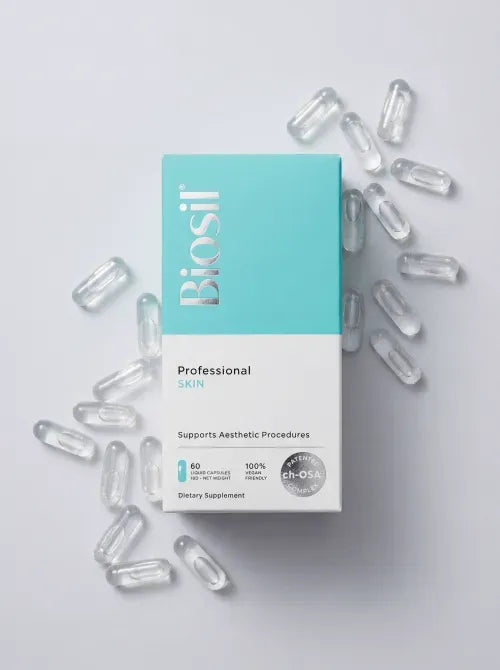
Generate your own collagen: supply a cofactor for collagen synthesis. ch-OSA® (choline-stabilized orthosilicic acid) from Biosil® is bioavailable silicon, not collagen. Silicon is also naturally present in hair (about 1 to 10 parts per million) and is thought to support the connective tissue the follicle depends on.
Two approaches to a collagen supplement for hair
| Approach |
What you take |
Proposed mechanism |
Type of human evidence |
| Ingested collagen peptides |
Pre-made collagen protein |
Amino acid building blocks after digestion |
Limited, mostly short cosmetic trials |
| ch-OSA® silicon (Biosil®) |
Bioavailable silicon, a cofactor for collagen synthesis |
Thought to support the follicle's collagen-rich support tissue and the hair strand |
A 9-month randomized placebo-controlled hair trial (manufacturer-funded) |
Generate Versus Ingest, Applied to the Follicle
The mechanism proposed by researchers is not that silicon becomes keratin, but that it supports collagen synthesis in the connective tissue around and beneath the follicle. A better-supported dermal papilla can produce a thicker strand. In cell studies, orthosilicic acid stimulated type 1 collagen synthesis, which is the plausibility basis for the whole approach. Silicon may also interact directly with keratin through its silanol groups, though this is a secondary hypothesis. Either way, ch-OSA® is positioned as generate-your-own-collagen background nutrition, an adjunct rather than a treatment.
Important boundary: none of this treats, prevents, or reverses hair loss, and none of it regrows hair. Hair thinning has many medical causes (thyroid, iron status, androgenetic patterns, and more) that need a clinician, not a supplement. A collagen-support supplement is about the appearance and quality of the hair you grow, not a cure for a condition.
What the Human Evidence Shows for Hair Strength and Thickness
The most directly relevant human trial for hair is Wickett 2007, and its actual numbers are more measured than most marketing suggests.
Wickett 2007 was a randomized, double-blind, placebo-controlled study. Forty-eight women with fine hair took either 10 mg of silicon per day as ch-OSA® or a placebo for 9 months. Two findings stand out. First, break load, the force needed to snap a hair, dropped significantly in the placebo group (about 10.8%) but stayed essentially stable in the ch-OSA® group (about 2.2%), so the supplement group largely held onto hair strength that the placebo group lost. Second, the cross-sectional area of the hair, a direct measure of thickness, increased significantly from baseline in the ch-OSA® group but not in the placebo group. Elasticity also declined less in the ch-OSA® group. The honest caveats: 48 people, one trial, and it was supported by a grant from the ch-OSA® manufacturer (Bio Minerals).
Reffitt 2003 again supplies the mechanism from cell culture: orthosilicic acid stimulated type 1 collagen synthesis in human cells. It is a signal for the mechanism, not proof of a hair benefit in people.
ch-OSA® and hair: what each study did and did not show
| Study |
Design |
What it measured |
Result |
Caveat to keep in mind |
| Wickett 2007 |
Randomized, double-blind, placebo-controlled, 48 women, 9 months |
Hair break load and thickness |
Strength held vs a significant placebo loss, thickness rose from baseline |
Single small trial, manufacturer-funded |
| Reffitt 2003 |
In vitro (human cell culture) |
Type 1 collagen synthesis |
Orthosilicic acid stimulated collagen synthesis |
Cells in a dish, not hair follicles |
Using a Collagen-Support Supplement for Hair Sensibly
-
Expect thickness and strength, not regrowth: the trial measured the quality of existing hair (strength and diameter), not new hair on a bald area. Frame your expectations accordingly.
-
Think in months: the hair study ran 9 months, in line with how slowly hair grows (roughly one centimeter per month). Give it a full cycle before judging.
-
Choose a bioavailable form: ch-OSA® is stabilized to raise silicon absorption, unlike generic silica.
-
Rule out medical causes first: sudden or patchy shedding deserves a clinician's workup (iron, thyroid, and other causes), and a supplement is not a substitute for that.
If your concern is facial firmness rather than hair, the same generate-your-own-collagen logic and a separate skin trial apply. See our companion guide on the best collagen supplement for sagging skin. To understand the active ingredient, read what ch-OSA® is, and see how we vet the science on our peer review page. Both guides live under our dermatology hub.
The Biosil® angle in one line: ch-OSA® is silicon, not ingested collagen or a hair-loss treatment. It provides a bioavailable cofactor thought to support the collagen your follicles depend on, as everyday appearance nutrition. Discuss any supplement with your treating clinician.
Sources
- Wickett RR, Kossmann E, Barel A, et al. Effect of oral intake of choline-stabilized orthosilicic acid on hair tensile strength and morphology in women with fine hair (randomized, double-blind, placebo-controlled; manufacturer-funded). Arch Dermatol Res. 2007;299(10):499-505. View source
- Reffitt DM, Ogston N, Jugdaohsingh R, et al. Orthosilicic acid stimulates collagen type 1 synthesis and osteoblastic differentiation in human osteoblast-like cells in vitro (cell-culture study, not human hair). Bone. 2003;32(2):127-135. View source
- Cleveland Clinic. Hair follicle: anatomy and function. View source