Dental Bone Graft Healing Stages: The 3-to-6-Month Timeline at a Glance
Most people want one answer first: how long does this take? Below is the short version, then the full breakdown. The bone graft healing stages move in order, and rushing them is not possible. Your job is to protect the site and let biology do its work.
How long does a dental bone graft take to heal?
A typical dental bone graft takes 3 to 6 months to heal enough for an implant. Small socket grafts can be ready closer to 3 to 4 months. Larger ridge grafts and sinus lifts often take 6 to 9 months, and sometimes up to 12 months. Soft tissue (the gum) closes in the first 1 to 2 weeks, but the bone underneath needs much longer to mature. The visible part heals fast. The structural part heals slowly.
Quick-reference healing stages timeline (table)
This table summarizes the five dental bone graft healing stages so you can see the whole arc at once. Times overlap and vary by person, graft type, and graft size.
| Stage |
Timeframe |
What is happening |
What you notice |
| 1. Blood clot and inflammation |
Days 1-3 |
Protective clot forms; inflammation begins repair |
Swelling and discomfort peak around day 2-3 |
| 2. Soft tissue healing |
Days 4-14 (Weeks 1-2) |
Gum closes over the site; new blood vessels form |
Swelling eases; site may look redder; pain fades |
| 3. Early bone formation |
Weeks 2-6 |
Osteoblasts start replacing the scaffold with new bone |
Little to feel; site feels firmer over time |
| 4. Bone integration and remodeling |
Months 1-3 |
Graft fuses with existing bone; density increases |
Normal daily function; site stable |
| 5. Bone maturation and implant readiness |
Months 3-6+ |
Bone matures; re-evaluated (often via CBCT) |
Cleared (or not yet) for implant placement |
Why healing time varies (small socket graft vs. sinus lift vs. large ridge graft)
Not every graft is on the same clock. A small graft placed in a fresh extraction socket has bone walls on most sides, so new bone grows in quickly. A large ridge graft, where width or height must be rebuilt, has more distance to fill and takes longer. A sinus lift sits in a delicate area and usually needs the longest wait. Smoking, diabetes, age, and graft material all shift the timeline too.
What Is a Dental Bone Graft and Why Does Healing Happen in Stages?
A dental bone graft is a procedure that adds bone material to a part of the jaw that has lost volume, usually from an extraction, gum disease, or long-term tooth loss. The reason healing happens in distinct bone graft healing stages is that bone is not poured in finished. It is rebuilt by your body, layer by layer, on the material the surgeon places.
What the graft material actually does (scaffold, not instant bone)
This is the single most important thing to understand. The graft material is a scaffold, not instant bone. It holds space and gives your own cells a structure to grow on. Over weeks and months, your body sends in blood vessels and bone-building cells that gradually replace the scaffold with living bone. So the "graft" you start with is mostly a placeholder. The real bone is the bone you make. For what actually changes between the starting point and the finished result, see dental bone graft before and after.
Why bone grafting is done before an implant
A dental implant needs enough solid bone to anchor into and stay stable for years. When the jawbone is too thin or too short, an implant placed there can loosen or fail. Grafting first rebuilds that foundation. It is an investment in the implant lasting, which is why dentists do not skip the wait, even when you feel fine after a couple of weeks. Whether you need a graft at all after an extraction is its own question; our guide on deciding if you need a bone graft after an extraction walks through it. Once the graft matures, the implant itself follows its own dental implant healing stages.
How graft type changes the timeline (autograft, allograft, xenograft, alloplast)
The source of the graft material affects how fast it integrates. Autograft (your own bone, often from another site) tends to integrate fastest because it carries living cells. Allograft (processed human donor bone), xenograft (processed animal bone, usually bovine), and alloplast (synthetic materials such as calcium phosphate) act mainly as scaffolds that your body replaces over months. None of these is "better" in every case; the surgeon picks based on the defect, the site, and your goals.
The 5 Dental Bone Graft Healing Stages, Step by Step
Here is the detailed walk-through. These are the same dental bone graft healing stages from the table above, expanded so you know what is happening inside and what to expect outside. If your graft went in at the same time as an extraction, our plainer walk-through of the tooth extraction and bone graft healing process covers both halves together.
Stage 1 - Blood clot and inflammation (Days 1-3)
Right after surgery, a blood clot forms over and within the graft site. That clot is the foundation for everything that follows, so protecting it is critical. In a fresh extraction socket, your surgeon may also place a collagen plug after tooth extraction to help hold and protect that clot. Inflammation kicks in, which sounds bad but is the body's repair signal. Swelling and discomfort usually peak around day 2 to 3. Mild oozing in the first 24 to 48 hours is normal. Do not rinse hard, spit, or use a straw during this window.
Stage 2 - Soft tissue healing and gum closure (Days 4-14 / Weeks 1-2)
By day 4 to 5, the worst swelling starts to ease. New blood vessels grow into the area, and the gum tissue begins closing over the graft. The site may look redder or pinker as it heals, which is expected. Pain should be fading, not building. Most people feel noticeably better by the end of week one and close to normal by week two, even though the bone underneath is far from finished. If your treatment also involved soft-tissue grafting, the gum follows its own path; see gum graft recovery.
Stage 3 - Early bone formation (Weeks 2-6)
Now the structural work begins. Bone-building cells called osteoblasts move in and start laying down new bone on the scaffold. This early bone formation is invisible from the outside; you will not feel it happening. The site gradually feels firmer and more stable. This is one of the most important of the bone graft healing stages because it sets up everything that follows, and it is silent, so patience matters.
Stage 4 - Bone integration and remodeling (Months 1-3)
During months 1 to 3, the new bone integrates with your existing jawbone and begins remodeling. Remodeling is the process where bone is reshaped and strengthened, raising density over time. You are back to normal daily life by now, eating and speaking without thinking about it. Underneath, your jaw is steadily converting that early scaffold-and-cell mix into more organized, load-ready bone.
Stage 5 - Bone maturation and implant readiness (Months 3-6+)
In the final stage, the bone matures into dense, stable tissue. From month 3 onward, your dentist may re-evaluate the site, often with a CBCT scan, to confirm enough new bone has formed and matured to hold an implant. Some sites are ready at 3 to 4 months; others need 6 months or more. This is the gate to your implant, and only imaging and your clinician can open it.
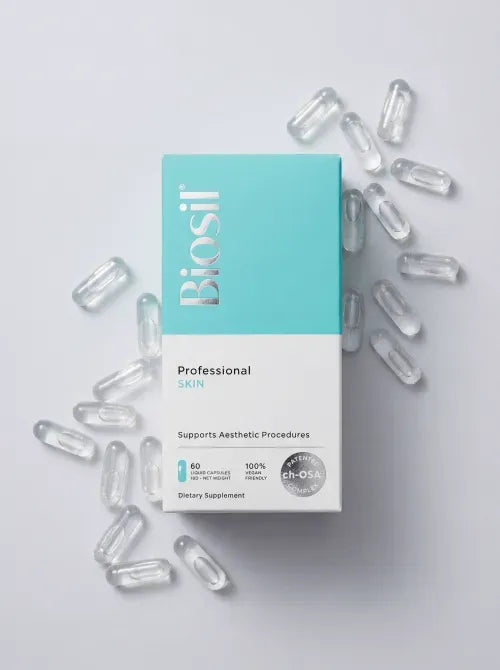
Why this matters for healing: new bone is roughly 30% collagen, the scaffold mineral binds to. Silicon (as ch-OSA®) is a cofactor your body uses to build its own collagen. This is reasoned from collagen biology, not proven in grafts, and is an adjunct to your dentist's care.
New to this molecule? What is ch-OSA®?
Day-by-Day: What a Healing Bone Graft Looks Like (Appearance Over Time)
People search for "bone graft healing stages pictures" because they want to know if what they see in the mirror is normal. We cannot show your specific site, and honestly, a stranger's photo can mislead you more than help. Appearance varies a lot. What follows is a description-based reference, which is more useful and less alarming than random images.
What's normal to see in the first week (and why "pictures" can mislead)
In the first week, expect some swelling, possible mild bruising, and a site that looks raw or red. You may see stitches and a small amount of whitish or yellowish film over the wound, which is part of normal healing, not pus. Photos online often show extreme or unusual cases, or different graft types, so comparing your mouth to a picture can cause needless panic. Trends matter more than snapshots: things should improve day over day.
Day 4 dental bone graft healing: what to expect
Day 4 is a common worry point, so here is the specific picture. By day 4, swelling is usually at or just past its peak and starting to ease. Discomfort should be manageable with prescribed or recommended medication and trending downward. The site may look redder as blood supply increases, and the gum edges are beginning to knit together. You should not have a fever, heavy bleeding, or pain that is getting worse on day 4. Those are reasons to call, not wait.
Seeing white or sandy particles (graft granules) - is it normal?
This is a top panic point, so let's be clear. Seeing a few small white, gritty, or sandy particles in your mouth in the first days can be completely normal. Many grafts use granular material, and a small number of loose granules near the surface can work free, especially with rinsing or chewing nearby. A few stray particles are usually not a failing graft. However, losing a large amount of material, or seeing the site noticeably empty out, warrants a prompt call to your dentist.
Appearance day-by-day reference (table)
| Timeframe |
Typical appearance |
Typical feeling |
| Day 1 |
Mild oozing, swelling starting, raw red site, gauze in place |
Numbness fading, mild discomfort |
| Days 2-3 |
Swelling and possible bruising peak, site red |
Peak discomfort, managed with medication |
| Day 4 |
Swelling easing, site redder, whitish healing film, sutures present |
Pain trending down, manageable |
| Day 7 |
Gum edges knitting together, sutures may remain |
Mostly comfortable |
| Days 8-14 |
Gum closing over site, color settling to pink |
Close to normal |
| Weeks 2-6 |
Surface looks healed; bone work hidden underneath |
Normal, site firmer |
| Months 1-6 |
Outwardly normal gum |
Normal; awaiting imaging clearance |
How to Know Your Bone Graft Is Healing Properly
Across all the dental bone graft healing stages, the simplest test is direction. Good healing trends toward less swelling, less pain, and more comfort, not the reverse.
Signs your healing is on track
Reassuring signs include: swelling and pain that gradually decrease after day 3, no fever, gum tissue visibly closing over the site, and only mild oozing limited to the first 24 to 48 hours. You should feel a little better most days. Small day-to-day ups and downs are normal, but the overall slope should be improvement.
Normal vs. warning symptoms
| Normal |
Warning (call your dentist) |
| Swelling peaking day 2-3, then easing |
Swelling worsening after day 3-4 |
| Pain fading with medication |
Severe or increasing pain |
| Minor oozing first 24-48h |
Heavy, persistent bleeding |
| A few loose granules early on |
Loss of most graft material |
| No fever |
Fever, pus, or foul taste/odor |
Signs of a Failed or Infected Dental Bone Graft
Graft failure is uncommon, but knowing the red flags lets you act early, when problems are most fixable. Trust the symptom, not your hope that it will pass.
Red-flag symptoms to act on (fever, pus, foul taste, spreading swelling, graft material loss)
Contact your dentist or oral surgeon promptly if you have any of these: fever, pus draining from the site, a persistent foul taste or odor, swelling that worsens or spreads after day 3 to 4, severe or increasing pain, heavy bleeding that will not stop, or loss of most of the graft material. One of these does not guarantee failure, but each one needs a professional to look, not a website to reassure you.
What graft failure means and what happens next
A failed graft means the body did not form enough new bone, often due to infection, a disturbed clot, smoking, or movement of the site. It does not usually mean you are out of options. In many cases the area is cleaned, allowed to settle, and re-grafted later. Catching trouble early gives the best chance of a clean redo, which is exactly why the warning signs matter.
When to call your dentist or oral surgeon
Call same-day for fever, pus, spreading swelling, or pain that is escalating instead of fading. Call within a day or two for anything that feels "off" past the expected window, like lingering bad taste or a site that stops improving. When in doubt, call. A two-minute phone check is far cheaper than a failed graft.
How to Speed Up Bone Graft Healing
You cannot rush the dental bone graft healing stages, but you can avoid sabotaging them, and you can give your body what it needs. Most "speeding up" is really "not slowing down." Our guide on what actually helps bone graft healing sorts the habits worth keeping from the noise.
The non-negotiables: no smoking, no straws, no disturbing the clot
Three rules protect the clot, and the clot protects the graft. Do not smoke or vape; smoking is one of the biggest causes of graft failure. Do not use straws; the suction can dislodge the clot. Do not spit forcefully, rinse hard, or poke the site. For the first days, gentle is the whole game.
Eating after a bone graft: when and what (soft-food timeline)
You can usually start soft, cool foods within the first 24 hours, chewing away from the site. Think yogurt, smoothies (by spoon, not straw), mashed potatoes, eggs, and soup that is not hot. Over the next 1 to 2 weeks, you reintroduce more normal foods as comfort allows and as your dentist guides. Avoid hard, crunchy, spicy, and hot foods early, and keep small particles like seeds and chips away from the area. For a fuller soft-food list that works here too, see what to eat after wisdom teeth removal.
Hygiene, medication, rest, and nutrition that support new bone
Keep your mouth clean with gentle oral hygiene, avoiding vigorous brushing right over the site until cleared. Take prescribed medications, including antibiotics, exactly as directed. Rest in the first days and keep your head slightly elevated. Eat protein and a range of vitamins and minerals, because new bone is built from raw materials your diet supplies. These nutrients support normal bone building; they do not speed up healing or replace your dentist's care.
Habits that slow healing down
The biggest culprits: smoking and vaping, alcohol in the early days, poking the wound with your tongue or fingers, skipping medications, heavy exercise too soon, and eating hard foods over the site. Each one fights against the bone graft healing stages your body is trying to complete. Removing them is often more powerful than adding anything.
Special Cases: Molar Grafts, Sinus Lifts, and Larger Grafts
Not every graft follows the standard chart. Two situations come up most.
Molar dental bone graft healing: what's different
Molar dental bone graft healing follows the same five stages, but molars carry the heaviest chewing load and sit in the back, where the bone can be denser and the sockets larger. Larger molar sockets may need more graft material and can take a bit longer to fully mature. The site is also harder to keep clean and easy to disturb while eating, so the soft-food and gentle-hygiene rules matter even more here.
Sinus lifts and large ridge grafts (6-12 month timelines)
Sinus lifts (which add bone in the upper back jaw beneath the sinus) and large ridge grafts (which rebuild significant width or height) are bigger projects. They commonly take 6 to 9 months, and sometimes up to 12, before an implant can go in. The early recovery still tracks the same stages, but the maturation phase is simply longer because there is more bone to build and mature.
When Can You Get an Implant After a Bone Graft?
This is the finish line everyone is waiting for. The answer is "when the bone, not the calendar, says so."
Typical wait of 3-6 months and how readiness is confirmed (CBCT / re-evaluation)
Implants are usually placed 3 to 6 months after grafting. Readiness is confirmed by your dentist, typically with imaging such as a CBCT scan, which shows whether enough new bone has formed and matured. Feeling healed is not the same as being ready; the surface heals long before the bone does. Larger grafts and sinus lifts push this wait toward 6 to 12 months.
Briefly: what a dental bone graft costs by type
Cost varies widely by region, surgeon, and graft size, so treat these as rough ranges and get a quote. A simple socket graft is generally the least expensive. Allograft, xenograft, and synthetic alloplast socket grafts often fall in a lower-to-mid range. Autografts and large ridge grafts cost more because of added surgical work, and sinus lifts are typically among the higher-cost procedures. Your dental office can give an exact figure and check insurance.
Sources
- Cleveland Clinic. Dental Bone Graft: Process, Purpose & Healing.
- Stanford CM, et al. Contemporary concepts in osseointegration of dental implants: a review. PMC9213185.
- Spector TD, et al. Choline-stabilized orthosilicic acid supplementation as an adjunct to calcium/vitamin D3 stimulates markers of bone formation in osteopenic females: a randomized, placebo-controlled trial. BMC Musculoskelet Disord. 2008;9:85. PMC2442067.
- Reffitt DM, et al. Orthosilicic acid stimulates collagen type 1 synthesis and osteoblastic differentiation in human osteoblast-like cells in vitro. Bone. 2003. PubMed 12633784.