Best Collagen Supplement for Sagging Skin: Start With How Collagen Is Actually Made
Sagging skin is not a sign that you ran out of collagen to swallow. It is the visible result of your skin slowly making less of its own collagen, and breaking down what it has faster than it rebuilds it. That single fact reframes the whole shopping question. The most useful supplement for sagging skin is not necessarily the one that contains the most collagen, it is the one that best helps your body form its own.
This guide explains why skin loses firmness, the difference between ingesting collagen and generating it, and what the human trial evidence actually shows for skin firmness and elasticity. It is general information about appearance and nutrition, not medical advice, so discuss any supplement with your own clinician.
Why skin starts to sag
The dermis, the deep layer of your skin, is roughly 70 to 80% collagen (mainly types I and III). Collagen is the scaffold that holds skin taut, and elastin lets it spring back. From your mid-twenties, collagen production drops by roughly 1% per year. Ultraviolet light, smoking, and pollution speed this up by activating enzymes that degrade collagen, and the drop in estrogen around menopause can remove a large share of skin collagen within a few years. Less collagen scaffold, plus weaker elastin, equals skin that looks looser and less firm.
The two ways a supplement can address it
Supplements marketed for sagging skin fall into two camps, and they are not the same thing.
-
Ingest collagen: collagen peptides or hydrolysed collagen. You swallow pre-made collagen protein, which is digested into amino acids and small peptides that your body may then use as building blocks.
-
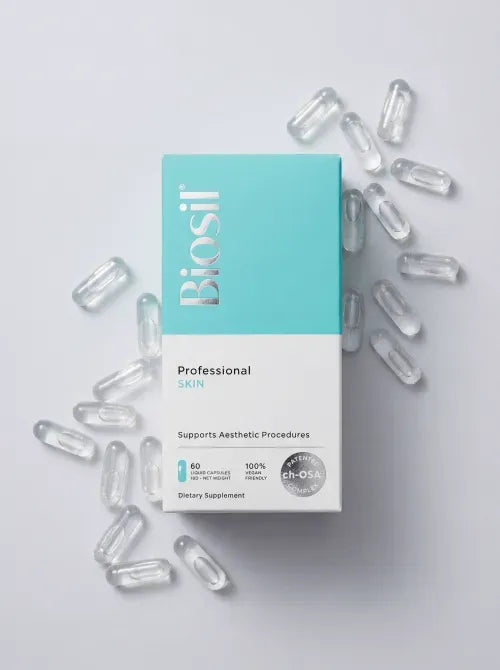
Generate your own collagen: supply a cofactor your body uses to build collagen itself. This is where silicon, and specifically ch-OSA® (choline-stabilized orthosilicic acid) from Biosil®, sits. It is not collagen. It is a bioavailable form of silicon thought to support your body's own collagen synthesis.
Two approaches to a collagen supplement for sagging skin
| Approach |
What you take |
Proposed mechanism |
Type of human evidence |
| Ingested collagen peptides |
Pre-made collagen protein |
Provides amino acid building blocks after digestion |
Several short cosmetic trials, often industry-funded |
| ch-OSA® silicon (Biosil®) |
Bioavailable silicon, a cofactor for collagen synthesis |
Thought to help the body form its own collagen and connective tissue |
A 20-week randomized placebo-controlled skin trial (manufacturer-funded) |
Generate Versus Ingest: The Distinction That Actually Matters
Your skin builds collagen through fibroblasts, the cells in the dermis that assemble collagen fibers. That assembly depends on cofactors. Vitamin C is one well-known cofactor. Silicon appears to be another: in cell studies, the enzyme prolyl hydroxylase, which is needed to build stable type I collagen, is sensitive to silicon availability. This is why the Biosil® angle is framed as generate, not ingest. Rather than adding pre-made protein to digest, ch-OSA® supplies bioavailable silicon that is thought to act as a cofactor for the collagen your fibroblasts already make.
Neither approach is a shortcut, and neither reverses sagging on its own. Firmness reflects long-term collagen turnover, sun protection, and overall health. A supplement is background nutrition, an adjunct to the basics (sunscreen, not smoking, sleep, a protein-adequate diet), never a replacement for them or for professional skin care.
Where silicon fits in the body
Silicon is a trace element present throughout connective tissue, skin, hair, and nails. Nutritional silicon deficiency in animal studies reduced collagen formation, which is part of why silicon is described as involved in building and maintaining connective tissue. ch-OSA® is simply a highly bioavailable, stabilized form designed so more of that silicon is actually absorbed.
What the Human Evidence Shows for Skin Firmness and Elasticity
The most directly relevant human trial for skin is Barel 2005. It is worth reading with its strengths and its limits in view.
Barel 2005 was a randomized, double-blind, placebo-controlled study. Fifty women with photodamaged facial skin took either 10 mg of silicon per day as ch-OSA® or a placebo for 20 weeks. In the ch-OSA® group, skin roughness measurements went down (for example, the main roughness parameters fell by roughly 16 to 19%), while they rose in the placebo group, and the difference between groups was statistically significant for two of the roughness measures. The study also reported an improvement in skin isotropy, which the authors linked to better elasticity, and lower self-rated brittleness of hair and nails. Two honest caveats belong next to these numbers: it is a single trial of 50 people, and it was supported by a grant from the ch-OSA® manufacturer (Bio Minerals). That does not erase the result, but it is why the claim stays at supports, not proves.
Reffitt 2003 adds the mechanism, in a test tube rather than in people: on human bone-forming cells in culture, orthosilicic acid stimulated the synthesis of type 1 collagen. Cell-culture evidence is a plausibility signal for the mechanism, not proof of a cosmetic effect in your skin.
ch-OSA® and skin: what each study did and did not show
| Study |
Design |
What it measured |
Result |
Caveat to keep in mind |
| Barel 2005 |
Randomized, double-blind, placebo-controlled, 50 women, 20 weeks |
Facial skin roughness and elasticity |
Lower roughness and improved isotropy vs placebo |
Single small trial, manufacturer-funded |
| Reffitt 2003 |
In vitro (human cell culture) |
Type 1 collagen synthesis |
Orthosilicic acid stimulated collagen synthesis |
Cells in a dish, not human skin |
How to Choose and Use a Collagen-Support Supplement Sensibly
If you decide to try a silicon-based, collagen-generation approach, a few practical points matter more than the label hype.
-
Form and bioavailability: plain silica is poorly absorbed. ch-OSA® is stabilized specifically to raise how much silicon your body can take up, which is the whole point of using it over a generic silica tablet.
-
Give it real time: the skin trial ran 20 weeks. Skin remodels slowly, so think in terms of months, not days. There is no visible overnight change with any collagen-support supplement.
-
Stack the basics first: daily sun protection and not smoking protect existing collagen far more than any capsule builds new collagen. A supplement is the adjunct, not the plan.
-
Talk to your clinician: especially if you are pregnant, breastfeeding, or on medication, run any new supplement past your treating clinician first.
If your main concern is thinning or weaker hair rather than facial firmness, the same generate-your-own-collagen logic and a separate human trial apply. See our companion guide on collagen supplements for hair. To understand the molecule itself, read what ch-OSA® is, and for how we handle the science, see our note on peer review. Both of these skin and hair guides sit under our dermatology hub.
The Biosil® angle in one line: ch-OSA® is silicon, not ingested collagen. It provides a bioavailable cofactor thought to support your body's own collagen formation, as everyday appearance nutrition rather than a treatment. Discuss any supplement with your treating clinician.
Sources
- Barel A, Calomme M, Timchenko A, et al. Effect of oral intake of choline-stabilized orthosilicic acid on skin, nails and hair in women with photodamaged skin (randomized, double-blind, placebo-controlled; manufacturer-funded). Arch Dermatol Res. 2005;297(4):147-153. View source
- Reffitt DM, Ogston N, Jugdaohsingh R, et al. Orthosilicic acid stimulates collagen type 1 synthesis and osteoblastic differentiation in human osteoblast-like cells in vitro (cell-culture study, not human skin). Bone. 2003;32(2):127-135. View source
- Cleveland Clinic. Collagen: what it is, types, function and benefits. View source