Why Collagen Falls So Fast at Menopause
Collagen is the structural protein that gives skin its firmness, bone its flexible scaffold, and connective tissue its resilience. Its production is partly driven by estrogen. When estrogen declines, collagen synthesis slows and breakdown continues, so the net balance turns negative.
The decline is not gradual. It is front-loaded into the years around the final period, which is why many women notice the change over a couple of seasons rather than a decade.
| Period |
What happens to skin collagen |
What women often notice |
| Perimenopause |
Synthesis starts to slow as estrogen fluctuates |
Skin feels drier, less bouncy, hair looks finer |
| First 5 years after the final period |
Roughly 30% of skin collagen is lost |
The fastest visible change in firmness and thickness |
| Years 5-20 |
Around 2% lost per year |
A slower, steadier drift |
| Bone, in parallel |
Bone turnover rises, and bone is roughly 30% collagen matrix |
Screening may show osteopenia |
That last row matters and is usually missed. Bone is not only mineral. Mineral is deposited onto an organic collagen matrix, so collagen quality is part of bone quality, not a separate topic.
Do Collagen Supplements Work for Menopause?
Partly, and only for some things. The honest summary is that the evidence is strongest for appearance and comfort, weakest for anything hormonal, and absent for the symptoms most women actually want gone.
| What women look for |
State of the evidence |
Reasonable expectation |
| Skin elasticity and firmness |
Several randomized trials in women, including trials of ch-OSA® |
Measurable changes over 4 to 6 months, not overnight |
| Hair and nail quality |
Randomized trials, small, mostly on strength and thickness |
Gradual change in condition, not regrowth |
| Bone collagen formation |
One 12-month randomized trial in osteopenic women (markers) |
Support alongside calcium and vitamin D, not a treatment |
| Joint comfort |
Mixed, mostly in other populations |
Uncertain, discuss with your clinician |
| Hot flashes, night sweats, mood |
No evidence |
None. These are hormonal, not structural |
No supplement in this category addresses the hormonal side of menopause. If hot flashes, sleep, or mood are the problem, that conversation belongs with a menopause clinician, and hormone therapy is a discussion a supplement does not replace.
Ingesting Collagen Versus Generating Your Own
Almost every product on the shelf is hydrolyzed collagen, meaning collagen protein from fish or cattle, broken into peptides. You swallow it, digest it into amino acids and peptides, and your body decides what to do with them.
There is a second route that is far less known. Your body already builds collagen continuously, using enzymes that require specific cofactors. Silicon is one of them, and it is involved in the enzymes linked to collagen cross-linking and maturation. Feeding the production line is a different strategy from supplying the finished material.
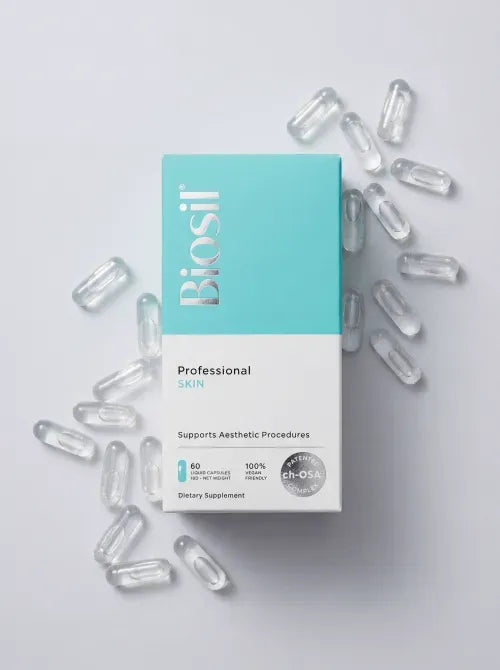
This is the whole point of ch-OSA®, choline-stabilized orthosilicic acid: it is a highly bioavailable form of silicon, not a collagen protein. It is why the Biosil® angle is generate, not ingest.
Which route suits menopause better?
Neither route is proven superior head to head, and no trial has compared them directly in menopausal women. What can be said is that the silicon route is the one with randomized, placebo-controlled trials run specifically in women in this age range, on the outcomes women in this age range report.
What the ch-OSA® Trials in Women Actually Showed
Three randomized, placebo-controlled trials are the backbone here. All three were run in women, and all three were funded by Bio Minerals NV, the manufacturer, which is worth stating plainly.
| Trial |
Population |
Design |
Main result |
| Barel 2005 |
50 women with photodamaged skin |
20 weeks, 10 mg Si/day vs placebo |
Skin roughness fell in the ch-OSA® group (Rt -16%, Rm -19%) while it rose on placebo (Rt +8%, Rm +11%), p<0.05 |
| Wickett 2007 |
48 women with fine hair, mean age 43 |
9 months, 10 mg Si/day vs placebo |
Hair elasticity was better preserved (-4.52% vs -11.9%, p=0.027); break load fell significantly on placebo (-10.8%) but not on ch-OSA® (-2.20%) |
| Spector 2008 |
184 osteopenic women, mean age 61 |
12 months, added to calcium and vitamin D3 |
PINP, a marker of bone collagen formation, was significantly higher at 12 months. The bone density change was a small trend, not a proven benefit |
Read those results for what they are. Barel and Wickett measured condition and appearance, not disease. Spector measured a formation marker in women already taking calcium and vitamin D3, so ch-OSA® was the add-on, never the therapy. None of these trials tested menopausal symptoms, and none of them should be read as doing so.
The mechanistic brick underneath is cell-culture work showing that orthosilicic acid stimulates type-1 collagen synthesis in human bone cells. That is in vitro, not human outcome data, and it is the reason the mechanism is described as thought to support rather than proven.
How to Read a Label at Menopause
The category is noisy, so a few practical filters help.
-
Check what the active actually is. Collagen peptides and silicon are two different strategies. Marine, bovine and type 1 versus type 2 are distinctions inside the peptide route only.
-
Look for vitamin C. It contributes to normal collagen formation, which is a permitted, well-established claim, and it is the one nutrient the body genuinely cannot skip when building collagen.
-
Judge the study population, not the study count. A trial in young athletes tells you little about a woman of 55.
-
Give it 4 to 6 months. Every trial above that showed anything ran for 20 weeks or longer. Skin and hair turn over slowly.
-
Check who funded the research, including ours.
Where to Go Next
This hub covers the shared biology. The detail for each concern sits in its own guide.
Perimenopause, Pregnancy and Postpartum: Where the Evidence Stops
Collagen demand does shift across other life stages, and the question comes up often, so it deserves a straight answer rather than a marketing one.
Perimenopause. The collagen decline begins here, before periods stop. Nothing in the trials above excludes this group, and the Wickett participants averaged 43 years of age, but no trial was designed specifically around perimenopause.
Pregnancy, breastfeeding and postpartum. There is no ch-OSA® trial in pregnant or breastfeeding women. Reasoning from collagen biology is not evidence, and pregnancy is exactly the setting where reasoning is not good enough. Do not start any supplement in pregnancy, while breastfeeding, or in the postpartum period without your obstetrician or midwife approving it first. That applies to this product as it does to any other.
What This Does Not Claim
- It does not treat, cure or prevent menopause or any condition, including osteoporosis or osteopenia.
- It does not reduce hot flashes, night sweats, mood changes or any hormonal symptom.
- It does not replace hormone therapy, calcium, vitamin D or your clinician's plan.
- It does not reverse wrinkles or regrow hair.
Biosil® does not contain collagen. It provides ch-OSA®, a bioavailable form of silicon thought to support your body's own collagen formation. It is nutrition alongside your care, never a replacement for it. Discuss any supplement with your treating clinician.
Sources
- Barel A, et al. Effect of oral intake of choline-stabilized orthosilicic acid on skin, nails and hair in women with photodamaged skin. Arch Dermatol Res. 2005. PubMed 16205932
- Wickett RR, et al. Effect of oral intake of choline-stabilized orthosilicic acid on hair tensile strength and morphology in women with fine hair. Arch Dermatol Res. 2007. PubMed 17960402
- Spector TD, et al. Choline-stabilized orthosilicic acid supplementation as an adjunct to calcium/vitamin D3 stimulates markers of bone formation in osteopenic females. BMC Musculoskelet Disord. 2008. PMC2442067
- Reffitt DM, et al. Orthosilicic acid stimulates collagen type 1 synthesis and osteoblastic differentiation in human osteoblast-like cells in vitro. Bone. 2003. PubMed 12633784
- Rzepecki AK, et al. Skin, hair and beyond: the impact of menopause. Climacteric. 2022. Climacteric 2022
- The North American Menopause Society. Menopause information for patients. menopause.org