What Collagen Induction Therapy Is (and How Microneedling Triggers New Collagen)
Collagen induction therapy (CIT), better known as microneedling, uses a device fitted with very fine needles to make hundreds of tiny, controlled punctures in the skin. Each channel is too small to leave a lasting mark, but it is enough to switch on the skin's natural repair response. That response is what lays down fresh collagen and elastin, the proteins that keep skin firm and smooth.
The treatment is done with a motorized pen or a roller, and the needle depth is matched to the area and the goal. Deeper settings reach further into the dermis and are used for scars, while shallower settings suit fine lines and general texture.
The controlled micro-injury principle
The idea is deliberate, minimal injury. The needles reach the upper dermis, the layer where collagen-producing cells (fibroblasts) live. Your body treats the micro-channels as small wounds and starts the healing cascade that rebuilds the collagen framework. Because the injury is controlled and spaced out, the skin repairs itself with new, organized collagen rather than scar tissue.
The wound-healing cascade, phase by phase
New collagen is not made instantly. It follows three overlapping phases, which is why results build over weeks and months rather than overnight.
How the skin responds after collagen induction therapy
| Phase |
Rough timing |
What the skin is doing |
| Inflammation |
0-3 days |
Blood vessels react, immune cells clear the micro-channels, growth factors are released |
| Proliferation |
3 days to ~3 weeks |
Fibroblasts multiply and lay down fresh collagen and elastin, new vessels form |
| Remodeling |
Weeks to months |
Early type III collagen is gradually replaced by stronger type I collagen, and skin firms |
What Collagen Induction Therapy Treats
Because it works by prompting new collagen, CIT is used for concerns tied to texture and firmness rather than surface pigment alone.
Fine lines, texture, and enlarged pores
Stimulating collagen can soften fine lines, smooth rough texture, and make enlarged pores look less obvious over a course of sessions. Results are gradual and cumulative, not a single dramatic change.
Acne scars, surgical scars, and stretch marks
One of the most common uses is improving the appearance of atrophic acne scars, where the skin sits in a depression. By encouraging new collagen under the scar, microneedling can help level the surface over time. It is also used for some surgical scars and stretch marks, though deeper scars need more sessions and realistic expectations.
What a Course of Treatment Looks Like
CIT is almost always a series, not a one-off, because collagen remodeling happens between sessions, not just during them.
How many sessions and how far apart
A typical plan is 3 to 6 sessions spaced roughly 4 to 6 weeks apart, giving the skin time to complete a remodeling cycle before the next round. Scars usually need the higher end of that range. After the initial course, some people book a maintenance session every 6 to 12 months.
A typical collagen induction therapy course
| Step |
Typical timing |
What happens |
| Consultation |
Before session 1 |
Skin assessment, treatment plan, and realistic expectations |
| Sessions 1-6 |
Every 4-6 weeks |
Numbing, the microneedling pass, then immediate redness |
| Remodeling |
Between and after sessions |
Collagen matures quietly over weeks to months |
| Maintenance |
Every 6-12 months |
Optional top-up once the course is done |
Collagen Induction Therapy Aftercare (Standard Clinical Guidance)
Aftercare is mostly about protecting freshly treated skin while its barrier recovers. Follow the specific instructions your provider gives you. The points below are typical guidance, not personal medical advice.
The first 24 to 72 hours
- Redness and warmth, like a mild sunburn, are normal and usually fade within 1 to 3 days.
- Use only a gentle cleanser and the products your provider approves. Keep the skin hydrated.
- Skip makeup for at least the first day, and avoid heat, saunas, vigorous exercise, and heavy sweating.
Days 3 to 14 and sun protection
- Avoid direct sun and wear a broad-spectrum SPF every day. New skin is sensitive to light.
- Pause retinoids, exfoliating acids, and scrubs until your provider clears you to restart.
- Let any light flaking shed on its own. Do not pick, rub, or peel the skin.
When You Will See Results (the Collagen Remodeling Timeline)
Because collagen remodeling is slow, results build in stages. Do not judge the outcome in the first week.
What to expect over time after collagen induction therapy
| Timeframe |
What you may notice |
| 1-3 days |
Redness settles, skin may look flushed and then brighter |
| 1-2 weeks |
Smoother surface and a temporary glow |
| 4-12 weeks |
Gradual firmness and texture improvement as new collagen forms |
| 3-6 months |
The fuller result of a course, with lines and scars looking softer |
Risks, Side Effects, and Who Should Avoid It
Common, short-lived effects include redness, mild swelling, dryness, and flaking for a few days. Less commonly, people see bruising, temporary breakouts, or, if aftercare is poor, infection. Professional treatment by a trained provider is safer than aggressive at-home rolling.
Talk to a professional before booking if you have active acne infection or cold sores in the area, an eczema or psoriasis flare, a tendency to form keloid scars, recent isotretinoin use, or if you are pregnant. Your provider will tell you whether CIT is appropriate for you and when.
Skin Collagen and Where ch-OSA® Fits (General Nutrition, Not a Procedure Aid)
Collagen is the protein that gives skin its structure and bounce, and the dermis is largely collagen. Your body builds that collagen using several nutrients, and silicon is one cofactor involved in the process. That is a fact about everyday skin biology, entirely separate from any clinical procedure.
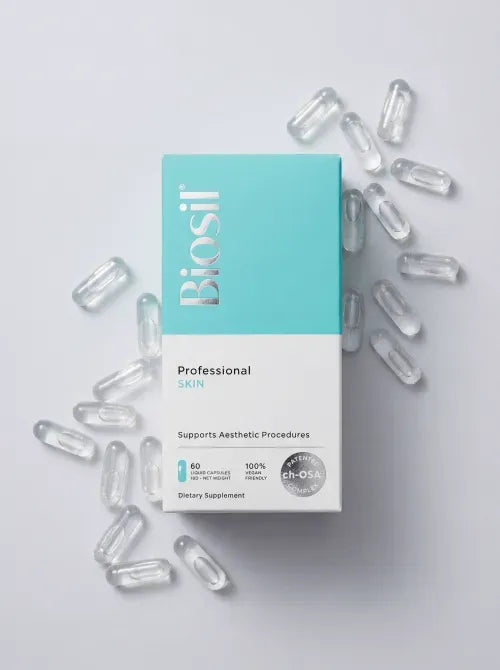
Biosil® provides ch-OSA® (choline-stabilized orthosilicic acid), a bioavailable silicon designed to help your body make its own collagen rather than eat pre-formed collagen. In a 20-week study in women with photodamaged skin, ch-OSA® was associated with a smoother skin surface and better elasticity (Barel 2005). New to the molecule? See What is ch-OSA®? and the peer-reviewed evidence.
Where ch-OSA® fits: your skin's firmness comes from a collagen framework, and silicon is a cofactor your body uses to build it. ch-OSA® supports your body's own collagen formation as general nutrition, not as a procedure aid. Discuss any supplement with your provider.
What this evidence does not say
- No study has tested ch-OSA® before or after microneedling or any collagen induction procedure.
- The connection is shared collagen biology, not proof that ch-OSA® changes how a procedure heals or performs.
- ch-OSA® is not shown to speed healing, cut downtime, reduce redness, prevent scarring, or improve your microneedling results.
- The main human skin study (Barel 2005) was funded by the supplement's manufacturer, so independent confirmation is limited.
- ch-OSA® is a food supplement and an adjunct to professional care, never a replacement. Discuss any supplement with your provider before adding it.
If you are planning treatment, arrange it with a qualified provider and treat general skin nutrition as background support, not part of the procedure. You may also want to read our guide to chemical peel aftercare, another collagen-focused way to resurface skin, or browse the full Biosil® aesthetic collagen guides.
Sources
- Cleveland Clinic. Microneedling: What It Is, Uses, Benefits and Results. View source
- Singh A, Yadav S. Microneedling: Advances and widening horizons. Indian Dermatol Online J. 2016. View source
- Reffitt DM, et al. Orthosilicic acid stimulates collagen type 1 synthesis and osteoblastic differentiation in human osteoblast-like cells in vitro (cell-culture study, not human skin or a procedure). Bone. 2003. View source
- Barel A, et al. Effect of oral intake of choline-stabilized orthosilicic acid on skin, nails and hair in women with photodamaged skin (manufacturer-funded). Arch Dermatol Res. 2005. View source