Collagen and Aesthetic Procedures: The Science Hub
Microneedling, lasers, radiofrequency, peels, a facelift, and a tummy tuck all lean on one biological process: your body building new collagen. This hub explains that shared biology in plain terms, weighs what the silicon evidence does and does not show, and points you to four in-depth guides.
Aesthetic

Collagen: The Common Thread Behind Aesthetic Procedures
Microneedling, fractional lasers, radiofrequency, chemical peels, a facelift, a tummy tuck: on the surface these are very different procedures. Underneath, most of them lean on the same biological process. They either prompt your skin to build fresh collagen, or they rely on your body's collagen-driven wound healing to settle the result. This hub explains that shared biology in plain terms, weighs honestly what the silicon evidence does and does not show, and points you to four in-depth guides.
What collagen is, and why procedures target it
Collagen is the main structural protein in skin, the scaffold that gives it firmness and bounce. From your mid-twenties onward your body makes a little less of it each year, and sun exposure speeds that loss. Many aesthetic procedures work by creating a controlled, precise injury. Your body then responds the way it responds to any injury, by clearing the damaged tissue and laying down new collagen and elastin. That remodeling is why results from these procedures build gradually over weeks and months rather than appearing overnight.
Two families: resurfacing and recovery
It helps to split the field in two. Collagen-stimulating procedures (microneedling, lasers, radiofrequency, peels) deliberately trigger new collagen as the mechanism of the result. Surgical procedures (facelift, abdominoplasty) do their work mechanically, then depend on collagen-based wound healing to close incisions and mature the scar. In both families your body does the actual rebuilding on its own timeline, which no product controls.
Why the starting point shifts with age

Every one of these procedures asks the same thing of you: produce new collagen. How readily you can do that is not constant across a lifetime. Skin collagen falls by roughly 1% a year from around age 21, and in the five years after menopause women commonly lose about 30% of it, largely because oestrogen both promotes collagen production and supports the enzyme pathway that keeps homocysteine, which degrades collagen, in check.

This is the honest reason nutrition comes up in an aesthetic conversation at all. Your practitioner is working on a tissue whose raw material supply is falling year on year, and that supply is the part of the equation you influence between appointments.
What Happens After the Procedure Sends the Signal
A procedure does not deposit collagen. It sends an instruction. Energy-based devices, peels and biostimulators upregulate collagen, elastin and keratin mRNA, and everything after that is manufacturing: the ribosome reads the instruction into a chain of amino acids, prolyl and lysyl hydroxylases modify specific residues, three chains wind into a triple helix, and lysyl oxidase cross-links the helices into fibrils and then into fibres. The cross-linking step is what gives a remodeled dermis its tensile strength.

Here is the number that makes the whole nutritional argument, and it comes from Bio Minerals' own literature: typically only about 10% to 30% of the collagen a person tries to make actually gets generated. The distance between the instruction and the finished protein is where enzymes, amino acids and cellular energy decide the result. Whether feeding that gap changes what a patient sees is the open question, and it is the honest way to frame the whole category.
This is also what separates ch-OSA® from an ordinary collagen supplement. Collagen peptides supply amino acid building blocks. ch-OSA® is aimed at the machinery that assembles them, and at protecting the network once it is built. Both can matter, and they are not the same intervention.

Where Biosil® Sits Next to a Treatment Plan
Practitioners ask a reasonable question: if a procedure works by triggering collagen, does it make sense to support collagen nutrition around it? Bio Minerals sets out its answer procedure by procedure in the professional literature it publishes for clinicians. We reproduce it here so you can see the argument in full and judge it yourself.

The argument holds together on its own terms. Procedures such as PRP, exosomes and fillers signal for collagen or improve fibroblast function, while the enzymes that actually build and cross-link collagen still have to do the work. Whether adding silicon nutrition changes what a patient ends up seeing in the mirror is a separate question, and it is one nobody has yet answered with a trial. Your practitioner is the person to weigh it for your case.
The professional formulation, and alpha-ketoglutarate
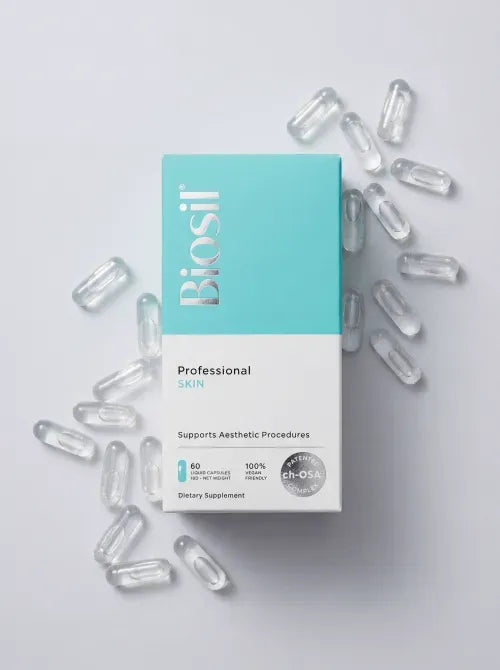
For practitioners, Bio Minerals produces a separate formulation, Biosil® Professional Ultra Collagen Generator, available only through licensed healthcare providers and not sold on this site. Each daily packet carries 10 mg of silicon and 200 mg of choline as ch-OSA®, plus 1,000 mg of alpha-ketoglutarate (AKG).
AKG is worth knowing about because, unlike ch-OSA®, its literature is not funded by Bio Minerals. It is a Krebs cycle intermediate studied for cellular energy production, for the synthesis of glutamate and glutamine (and through them proline, the amino acid collagen is most hungry for), for activating prolidase to recycle glycine and proline out of damaged collagen, and for its influence on DNA demethylation enzymes. A 2020 paper in Cell Metabolism and reviews in Trends in Endocrinology and Metabolism sit behind that work. None of it tested this product, and none of it is about aesthetic procedures, but it is independent science rather than manufacturer material.
What the Evidence Says About Silicon and Collagen
Because collagen sits at the center of all this, silicon comes up as a nutrient of interest, since silicon is thought to act as a cofactor the body uses when it forms collagen. It is worth being precise about how strong that evidence actually is.
The most cited human study is a skin trial, Barel et al. 2005, in which fifty women with photo-damaged skin took 10 mg of silicon a day as choline-stabilized orthosilicic acid (ch-OSA®), or a placebo, for 20 weeks. The trial measured skin roughness from a microrelief cast and mechanical anisotropy, a marker of photo-ageing.


Two caveats matter here. First, the trial looked at everyday skin condition in untreated skin, not recovery from any procedure. Second, it was funded by the ingredient's manufacturer, which is a limitation to weigh. A separate in-vitro study (Reffitt et al. 2003) showed orthosilicic acid stimulating type-1 collagen synthesis in cultured cells, which is laboratory evidence, not a result in people. Taken together this is a reasoned nutritional rationale, not proof of any procedure benefit.
How to read the case documentation below
Everything that follows is uncontrolled clinical observation: individual patients in one physician's practice, photographed before and after, with Biosil® taken alongside a procedure. There is no placebo group and no blinding, so the changes you see cannot be separated from the procedure itself, from natural variation, or from lighting and positioning. No ch-OSA® study has tested the ingredient around microneedling, laser, radiofrequency, a chemical peel, a facelift or a tummy tuck, and we do not claim it speeds recovery, reduces downtime or improves any procedure's result. Individual results vary. This material is published with patient consent because it is what the clinicians using the product actually report, and you are entitled to see it and weigh it yourself. It is not a substitute for your own practitioner's judgement.
Clinical Case Documentation
These cases come from a February 2025 medical program workshop presented by Dr. Anna Tsebrovska, MD, an aesthetic physician, documenting patients who took Biosil® alongside dermatological procedures in her own practice.
Botulinum toxin and hyaluronic acid fillers

The clinician's reading: the skin held its elasticity rather than sagging under the filler, and 2 ml of hyaluronic acid in total, 1 ml in the cheekbone area and 1 ml in the nasolabial folds, produced more than she would normally expect from that volume.
Lipolytic injections

Losing facial fat volume normally risks leaving loose skin behind. The clinician's observation here was that the contour tightened rather than slackened.
Radiofrequency microneedling

This is the clearest illustration of the mRNA argument above. The device punctures deeply and delivers heat, which is a powerful stimulus to produce collagen and elastin mRNA. What happens next depends on the enzymes that turn that instruction into protein.
Scars and stretch marks


Her framing is worth quoting in substance: microneedling and peels are a deliberately negative stimulus, so the regeneration has to be supported from the inside if new skin is going to fill a scarred area well.
Deep retinol peels

The reported benefit here was about tolerability rather than the result: at 5% retinol the skin usually becomes thin, hypersensitive and peels badly, and the clinician found that phase passed more smoothly. That is a comfort observation from one practice, not a measured endpoint.
Complexion imaging at 90 days

Read this one carefully, because the numbers are percentile ranks against age-matched peers, where higher is better, and they do not all move the same way. In the first patient wrinkles improve from the 57th to the 89th percentile and pores from 59 to 73, while texture falls from 47 to 17. In the second, spots improve from 29 to 77 and texture from 26 to 38, while UV spots fall from 87 to 66. TruSkin Age, a proprietary composite score rather than a clinical measurement, drops in both. Two patients, no control group, mixed movement across the individual metrics: interesting, not evidence.
Practical Questions People Ask

These answers come from the manufacturer's professional documentation for ch-OSA®. They describe the product and its known limits. None of them is medical advice, and none of them changes the position set out above.
- Who should not take it. People with kidney failure or on kidney dialysis are generally advised not to take silicon-containing supplements. If that applies to you, this is a conversation for your doctor before anything else.
- Tolerance and side effects. The manufacturer reports no side effects in its clinical studies, and the product has been sold since 1995. Very rarely, people highly sensitive to choline have reported digestive discomfort, palpitations or restlessness. Taking it with food is the usual suggestion where that happens.
- Does it need to be paused around a procedure. The manufacturer's position is that it does not, unlike some supplements and many topical treatments. Your surgeon or practitioner decides this, not a brochure and not us. Tell them what you are taking.
- When would a practitioner start it. The manufacturer suggests beginning at the first pre-procedure consultation and continuing afterwards, on the logic that collagen remodeling runs for months after the appointment. Treat that as a suggested regimen from the manufacturer, not as a validated protocol.
- Is there a cycle to follow. No treatment holiday is described, and no tolerance is reported to build. Some clinicians nonetheless run it in courses, as in the cases above.
- Pregnancy and breastfeeding. Collagen and connective tissue demands do rise in pregnancy, and the manufacturer states the product can be taken then. Treat that as the manufacturer's position, not as clearance: clear any supplement with your midwife or doctor first.
One further point on expectations. Silicon is absorbed quickly, but collagen remodeling is slow, and the skin trial above needed 20 weeks to show a difference between its two groups. Nothing in this area works on the timescale of a procedure's downtime.
Explore the Aesthetic Collagen Guides
Four detailed guides go deeper into the procedures people ask about most. Each explains the mechanism, the realistic timeline, and the aftercare, with the same honest framing you find here.
- Collagen induction therapy: how microneedling uses controlled micro-injury to prompt new collagen, what a course involves, and what results are realistic.
- Chemical peel aftercare: how peels resurface skin, the day-by-day recovery window, and how to protect the new skin underneath.
- Facelift recovery time: the week-by-week healing timeline, what is normal at each stage, and when you look socially ready.
- Tummy tuck recovery time: the abdominoplasty healing stages, activity restrictions, and how the scar matures.
Related hubs and resources
To understand the molecule behind the nutrition angle, read what ch-OSA® actually is, and see how we handle evidence on our peer-review approach. Biosil® also maintains sibling science hubs for dermatology and dental procedures, where collagen plays a similar background role. The dermatology hub carries the full map of the ch-OSA® skin, hair and nail trials and states which of them are controlled and which are not.
Sources
- Barel A, et al. Effect of oral intake of choline-stabilized orthosilicic acid on skin, nails and hair in women with photodamaged skin (manufacturer-funded). Arch Dermatol Res. 2005;297:147-153. View source
- Reffitt DM, et al. Orthosilicic acid stimulates collagen type 1 synthesis and osteoblastic differentiation in human osteoblast-like cells in vitro (cell-culture study, not human). Bone. 2003. View source
- Gaviglio et al. Choline-stabilized orthosilicic acid: applications of an oral supplement in dermatology. Journal of Plastic and Pathology Dermatology. 2023.
- Moraru et al. Presented at the European Wound Management Association conference, Barcelona, 2025.
- Shahmirzadi AA, et al. Alpha-ketoglutarate, an endogenous metabolite, extends lifespan and compresses morbidity in aging mice. Cell Metabolism. 2020;32(3):447-456.
- Gyanwali B, et al. Alpha-ketoglutarate dietary supplementation to improve health in humans. Trends in Endocrinology and Metabolism. 2022;33(2).
- Naeini SH, et al. Alpha-ketoglutarate as a potent regulator for lifespan and healthspan. Experimental Gerontology. 2023;175:112154.
- Brincat M, et al. A study of the decrease of skin collagen content, skin thickness and bone mass in the post-menopausal woman. Obstetrics and Gynecology. 1987.
- Shuster S. Osteoporosis, a unitary hypothesis of collagen loss in skin and bone. Medical Hypotheses. 2005.
- Wang F, et al. In vivo stimulation of de novo collagen production caused by cross-linked hyaluronic acid dermal filler injections in photodamaged human skin. Arch Dermatol. 2007.
- MacGregor L, et al. Microfocused ultrasound for skin tightening. Semin Cutan Med Surg. 2013.
- EFSA Panel on Food Additives and Nutrient Sources. Scientific opinion on choline-stabilised orthosilicic acid added for nutritional purposes to food supplements. EFSA Journal. 2009.
- Tsebrovska A, MD. Clinical case studies using Biosil in conjunction with dermatological procedures, medical program workshop, February 2025. Uncontrolled case documentation, published with patient consent.
- Cleveland Clinic. Microneedling: procedure, benefits, and recovery. View source
- Cleveland Clinic. Collagen: what it is and how to support it. View source
- Figures, tables and photographs on this page are reproduced from the Bio Minerals NV clinical and professional documentation for ch-OSA®.
Collagen and Aesthetic Procedures: Frequently Asked Questions
What practitioners and patients ask most about :
Do aesthetic procedures really work by building collagen?
Many do. Microneedling, lasers, radiofrequency and peels create a controlled injury that prompts your body to lay down fresh collagen and elastin, which is why results build over weeks. Surgical procedures like a facelift or tummy tuck rely on collagen-based wound healing to close and mature the incision.
Can a supplement improve my results from microneedling, laser or a peel?
No published ch-OSA® or silicon study has tested a supplement before or after these procedures, so there is no evidence it improves a result, speeds recovery or reduces downtime. ch-OSA® is positioned only as general collagen nutrition. Discuss any supplement, and its timing, with your provider.
What is collagen induction therapy?
Collagen induction therapy is another name for microneedling: fine needles create controlled micro-injuries in the skin, and the body responds by producing new collagen as it heals. Our dedicated guide walks through what a course involves and what results are realistic.
Does silicon or ch-OSA® help skin collagen?
A manufacturer-funded skin trial (Barel 2005) linked oral ch-OSA® over 20 weeks to better skin surface and elasticity markers, and a cell-culture study showed orthosilicic acid stimulating collagen. This is a reasoned nutrition rationale for everyday skin, not proof of any procedure benefit.
Should I take a collagen supplement before or after a procedure?
It is not required, and no ch-OSA® study has tested that timing. Any supplement is background nutrition at most, never a substitute for your surgeon or dermatologist's aftercare. Always clear it with your treating provider first, especially around surgery.
How ch-OSA® from Biosil® Fits Into General Collagen Nutrition
Biosil® provides ch-OSA®, a bioavailable form of silicon. Silicon is thought to act as a cofactor your body uses when it forms collagen, so ch-OSA® is framed as general nutrition for your body's own collagen production, not as anything that acts on a treated area or a procedure. No ch-OSA® trial has tested it before or after an aesthetic procedure, and a supportive skin study (Barel 2005) was industry funded. Discuss any supplement with your provider.
- Provides bioavailable silicon, a cofactor your body is thought to use when it forms collagen, to support its own everyday production of the collagen found throughout skin and connective tissue.
- Designed to help your body generate its own collagen rather than swallow it, framed as general background nutrition, not as anything acting on a treated area or a procedure result.
- A low-risk adjunct, not a fix: FDA GRAS status, positive EFSA opinions, and 30+ years of use. It never replaces clinical care, so discuss any supplement with your provider.