Silicon, Collagen and Your Skin, Hair and Nails: The Dermatology Hub
Your skin, hair and nails are largely built on collagen, and silicon is a cofactor your body uses to make it. This hub explains the ch-OSA® approach (generate your own collagen rather than ingest it), previews the peer-reviewed evidence with its limits, and points you to the four guides for skin, hair, nails and acne scars.
Dermatology

Silicon, Collagen and Your Skin, Hair and Nails
Skin, hair and nails share one thing: they are built on, or held together by, collagen. Skin is roughly 70% collagen by dry weight, hair grows from a collagen-rich follicle, and the nail bed sits on connective tissue. When people reach for a supplement to firm skin, strengthen hair or harden nails, the real target underneath all three is the same protein.
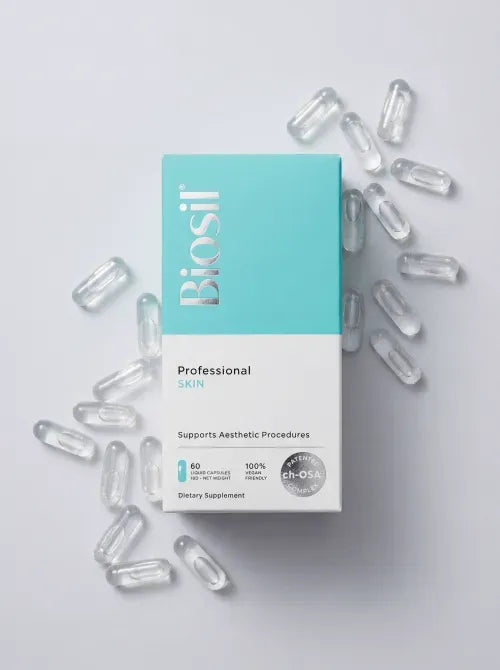
Biosil® approaches that target differently from most collagen products. Instead of asking you to ingest collagen, it supplies ch-OSA® (choline-stabilized orthosilicic acid), a bioavailable form of silicon that acts as a cofactor your body uses to build its own collagen. The Biosil® position in short: generate your own collagen, do not ingest it. This hub explains where that idea holds up, where the evidence is thin, and which guide to read for your specific concern.
Why collagen becomes the limiting factor
Collagen makes up roughly 5% to 7% of body weight and about three quarters of the dry weight of skin. It is not a fixed structure. It is continuously broken down and rebuilt, which means the body has to keep manufacturing it for life. From around age 21 the collagen content of skin falls by roughly 1% a year, and in the five years following menopause women commonly lose about 30% of their skin collagen. The chart below, from the Bio Minerals clinical documentation, shows that trajectory for men and women.

Loss also gets accelerated from the outside in: homocysteine, cortisol from chronic stress, glycation, UV exposure and free radicals all degrade existing collagen faster than the body replaces it. That is the gap a collagen-generation approach is aimed at, and it is a nutritional gap, not a medical one.
Where ch-OSA® fits, and where it does not
ch-OSA® supports your body's general collagen formation. That is a nutritional role, not a medical one. It does not treat, cure or reverse any skin, hair or nail condition, and it is not a substitute for a dermatologist. Treat it as background nutrition for the collagen scaffold, best used alongside good skincare, sun protection and, where needed, clinical care. New to the molecule? Start with what ch-OSA® actually is.
How Silicon Acts on the Collagen Pathway
Collagen is not assembled in one step. A strand of collagen mRNA is read into a chain of amino acids, that chain is hydroxylated, three chains wind into a triple helix, and the helices are then cross-linked into fibrils and fibres. Each of those steps depends on a specific enzyme, and silicon is involved in several of them. The diagram below maps where ch-OSA® is understood to act on that sequence.

Three of those points matter for skin, hair and nails in particular:
- Enzyme activation. Prolyl and lysyl hydroxylases convert proline and lysine into hydroxyproline and hydroxylysine, without which a stable triple helix cannot form. Lysyl oxidase then cross-links the helices into fibres, which is what gives a collagen network its tensile strength.
- Protection of what already exists. Homocysteine and cortisol both degrade collagen and elastin networks. The choline in the ch-OSA® complex is involved in homocysteine metabolism.
- Network quality, not just quantity. Collagen sits in a matrix alongside elastin, proteoglycans such as decorin, and glycosaminoglycans such as hyaluronic acid. Silicon is structurally associated with that wider matrix.
A useful number sits behind all of this. Producing collagen starts with transcribing the instruction into mRNA, but only about 10% to 30% of that instruction is typically converted into finished protein. The distance between the signal and the protein is where enzymes, amino acids and cellular energy decide the outcome, and that is the gap nutrition is aimed at.
Hair and nails add a fourth mechanism, because their growth sites are themselves collagen structures. The dermal papilla at the base of a hair follicle and the nail matrix under the cuticle both determine how thick the shaft or plate they produce will be, and both are collagen-dependent.

There is also a fifth route that applies only to hair and nails. Some orthosilicic acid is incorporated directly into keratin, where it helps link keratin fibres to one another. That bond-building action is what the manufacturer credits for reduced breakage, fraying and split ends, and it happens in the shaft itself rather than at the follicle.

What the Evidence Actually Shows
Two peer-reviewed ch-OSA® trials are the ones most often cited for skin and hair. They are worth knowing about, and worth reading with a clear head about their limits. The figures below are the trial data as published by Bio Minerals NV, with what each one does and does not demonstrate spelled out underneath.
Skin: Barel 2005
Fifty women aged 40 to 65 with photo-damaged facial skin took 10 mg of silicon a day as ch-OSA®, or a placebo, for 20 weeks. The measured endpoints were skin roughness (a microrelief cast read for depth of roughness) and mechanical anisotropy, an indicator of photo-ageing that improves as skin becomes more isotropic, meaning it resists stretching evenly in every direction rather than in one favoured axis.

The distinction matters. In the published paper, roughness parameters rose in the placebo group and fell in the ch-OSA® group, with the difference between the two reaching statistical significance for depth of roughness and maximum roughness. What the trial shows is a divergence between the groups over 20 weeks. It does not show that ch-OSA® removes wrinkles.

Nail and hair brittleness, scored by the participants on a visual analogue scale, were secondary findings in the same trial.
Hair: Wickett 2007

Forty-eight women with fine hair took 10 mg of silicon a day as ch-OSA®, or a placebo, for nine months. Hair fibres were tested on a tensile tester, and cross-sectional area was measured separately.

The same pattern holds for elasticity: the elastic gradient declined in both groups, but significantly less in the ch-OSA® group. The one measure that genuinely increased against baseline was cross-sectional area, the thickness of the individual fibre, which rose significantly in the ch-OSA® group and not in the placebo group.

One reason a hair trial has to run for nine months is the growth cycle itself. Around 85% of follicles are in the anagen, or growing, phase at any moment. A follicle then passes through catagen, rests in telogen, sheds the old club hair in exogen and re-enters anagen. Nutrition can only influence a shaft while it is being formed, so any change shows up on the timescale of the cycle, not of the supplement.

Beyond these two randomised trials there is a pilot study in people with androgenic alopecia, alopecia areata and other causes of hair loss. Its principal investigator judged that 89% of participants improved after six months, and 94% of participants said themselves that their hair had improved. That is an open-label pilot with no placebo arm, so it is a signal worth reporting and not evidence of efficacy.
Nails
Nail brittleness was scored on a visual analogue scale in the Barel trial and fell significantly in the ch-OSA® group against baseline, with no significant change in the placebo group.

A separate open-label study in women with fragile nails documented improvements in the roughness of the nail lamina and a reduction in longitudinal ridging. The photographs below follow one 55 year old participant at baseline, three months and six months, with the lower row taken through a video dermatoscope at 20x magnification.

The full dermatology trial map
Here is every ch-OSA® study in the dermatology area, with its design stated plainly. Only the two double-blind randomised controlled trials carry real evidential weight. The open-label, single-arm studies have no placebo group, which means their results cannot be separated from natural variation and expectation.
| Area | Study and design | Population | What was observed |
|---|---|---|---|
| Skin | Barel et al. 2005, double-blind RCT | Women with photo-aged skin, 40 to 65 | Reduced roughness and improved skin isotropy versus placebo at 20 weeks |
| Skin | Chandrashekar et al. 2020, open label, single arm | Women with photo-aged skin, 40 to 65 | Reported improvement in hydration, tone and roughness versus baseline at 5 months |
| Hair | Wickett et al. 2007, double-blind RCT | Women with fine hair, 18 to 65 | Smaller decline in break load and elasticity than placebo, and increased cross-sectional area, at 36 weeks |
| Hair | Chan 2006, open label, single arm | People with androgenic or other alopecia, 17 to 54 | Investigator judged 89% improved at 6 months; 94% of participants felt they improved |
| Hair | Chandrashekar et al. 2020, open label, single arm | People with alopecia, 17 to 54 | Increased hair density versus baseline at 5 months |
| Nails | Barel et al. 2005, double-blind RCT | Women with photo-aged skin, 40 to 65 | Decreased self-reported nail brittleness versus baseline at 20 weeks |
| Nails | Bruni et al. 2018, open label, single arm | Women with fragile nails, 18 to 65 | Reported improvement in nail roughness, splitting and longitudinal ridges at 6 months |
The honest caveat. Both randomised trials were small, and both were supported by the manufacturer of the ingredient. That lowers how much certainty you should read into them. They are suggestive, not conclusive, and neither shows ch-OSA® treating a disease. In several of the headline figures the effect is a slower decline rather than an improvement, which is a real result but not the same claim. We keep the studies, their funding and their limitations in plain sight on the peer review page.
Clinician Case Observations
Read this section differently from the one above. What follows is uncontrolled documentation of individual patients in one physician's practice, photographed before and after, who took Biosil® alongside dermatological treatments. There is no placebo group and no blinding, so nothing here can be attributed to the supplement rather than to the treatment, to time, or to photography. ch-OSA® is a food supplement and does not treat, cure or prevent any disease, including any of the conditions named below. Individual results vary. We publish this because it is what practitioners using the product report, and you should be able to see it and judge it yourself. Any skin condition belongs with a dermatologist first.
These cases were presented by Dr. Anna Tsebrovska, MD, an aesthetic physician, at a February 2025 medical program workshop.
Facial redness

The clinician's proposed explanation rests on choline rather than silicon, through its role in nerve membrane structure. That is a hypothesis offered by one practitioner, and no trial has tested it.
Facial pigmentation

Scalp hair density

Worth comparing with the Wickett trial above, which measured hair on a tensile tester over nine months and found a difference against placebo in strength and thickness rather than in density. Photographs of density and instrument measurements of a single fibre are not the same evidence, and only one of the two had a control group.
Further cases documenting Biosil® taken alongside injectables, radiofrequency microneedling, scar protocols and chemical peels are set out on the aesthetic hub, with the same caveats.
What a Realistic Timeline Looks Like

Silicon absorption is fast, but collagen turnover is not, and hair and nails only reveal a change once new tissue has grown out. The sequence below is drawn from the clinical trial endpoints and from case reports, so treat the early entries as what people commonly report and the later ones as what the trials actually measured. Age, diet, genetics and lifestyle all shift it.
- Within 30 minutes. The ch-OSA® complex is absorbed and available to collagen-producing cells.
- 1 month. Faster nail growth is one of the first things people report, because the nail plate is a visible growth record.
- 2 months. Hair volume and growth are commonly reported to change. In the open-label pilot, 67% of people began to see a difference in hair density by this point.
- 3 months. Reported improvements in skin luminosity, from user reports rather than a controlled trial.
- 4 to 5 months. The window in which the Barel trial measured its skin roughness and isotropy differences against placebo.
- 4 to 6 months. The window for the nail brittleness change in Barel, and for the reduction in ridging and roughness in the open-label nail study.
- 9 months. The endpoint of the Wickett hair trial, the point at which the difference in tensile strength and thickness was measured.
The practical reading: nothing here is a quick fix, and anything promising a visible change in a fortnight is not describing collagen biology.
Who should not take it
People with kidney failure or on kidney dialysis are generally advised against silicon-containing supplements. The manufacturer reports no side effects in its clinical studies, with rare exceptions in people highly sensitive to choline, who have described digestive discomfort, palpitations or restlessness. Discuss any supplement with your doctor, and particularly so in pregnancy or while breastfeeding.
Explore the Dermatology Guides
Four in-depth guides sit under this hub. Each one is honest about where ch-OSA® can support general collagen nutrition and where it cannot do the work for you.
- Collagen support for sagging skin: why skin loses firmness with age, and how the collagen-generation approach fits alongside sun protection and skincare.
- Collagen support for hair: what actually drives hair strength and thickness, and where silicon nutrition sits among the real levers.
- Collagen support for nails: what makes nails weak or splitting, and how to support the nail bed's connective tissue.
- How to get rid of acne scars: the treatments that genuinely resurface scarred skin, and the supporting role of collagen nutrition.
Related Biosil® Hubs
Silicon and collagen matter beyond skin. For surgical or aesthetic recovery, see the aesthetic recovery hub. For bone, gum and implant healing, see the dental hub. Both apply the same generate-your-own-collagen principle to a different tissue.
Sources
- Barel A, et al. Effect of oral intake of choline-stabilized orthosilicic acid on skin, nails and hair in women with photodamaged skin (manufacturer-supported). Arch Dermatol Res. 2005;297:147-153. View source
- Wickett RR, et al. Effect of oral intake of choline-stabilized orthosilicic acid on hair tensile strength and morphology in women with fine hair (manufacturer-supported). Arch Dermatol Res. 2007;299:499. View source
- Reffitt DM, et al. Orthosilicic acid stimulates collagen type 1 synthesis and osteoblastic differentiation in human osteoblast-like cells in vitro (cell-culture study, not skin). Bone. 2003. View source
- Calomme MR, Vanden Berghe DA. Silicon absorption from choline-stabilized orthosilicic acid (manufacturer-supported bioavailability work). 2000.
- Chandrashekar BS, et al. Assessment of anti-ageing effects of oral choline-stabilized orthosilicic acid on hair, skin and nails: an open label, non-randomized interventional study. Int J Res Dermatol. 2020;6:450-455.
- Chan GP. An open clinical study of the efficacy of choline-stabilized orthosilicic acid in the management of declining hair density, a pilot study. Proceedings, 17th Regional Conference of Dermatology, Bali, 2006.
- Bruni F, et al. Evaluation of a choline-stabilized orthosilicic acid supplement in female nail fragility. Proceedings, 93rd Congresso Nazionale SIDeMaST, Verona, 2018.
- Gaviglio et al. Choline-stabilized orthosilicic acid: applications of an oral supplement in dermatology. Journal of Plastic and Pathology Dermatology. 2023.
- Tsebrovska A, MD. Clinical case studies using Biosil in conjunction with dermatological procedures, medical program workshop, February 2025. Uncontrolled case documentation.
- Figures, diagrams and photographs on this page are reproduced from the Bio Minerals NV clinical and professional documentation for ch-OSA®.
Silicon, Collagen and Skin: Frequently Asked Questions
What practitioners and patients ask most about :
Can silicon or collagen supplements really improve skin, hair and nails?
The honest answer is nuanced. ch-OSA® provides bioavailable silicon, a cofactor your body uses when it forms collagen, the protein that makes up much of skin and supports hair and nail structures. Small ch-OSA® trials (Barel 2005 on skin, Wickett 2007 on hair) reported improvements in elasticity and hair strength, but both were manufacturer-supported and modest in size. Treat it as general nutritional support, not a cure, and discuss it with your clinician.
What is the difference between ingesting collagen and generating your own?
Eating collagen peptides gives your body amino acid building blocks. The ch-OSA® approach is different: you supply silicon, a cofactor your body uses to build its own collagen. Biosil®'s position is generate your own collagen rather than ingest it. Neither approach treats a skin condition; both are background nutrition alongside skincare and clinical care.
Which Biosil® guide should I read for my concern?
For loss of firmness and sagging, read the sagging skin guide. For thinning or fragile hair, the hair guide. For weak or splitting nails, the nails guide. For post-acne marks and texture, the acne scars guide. Each one explains where ch-OSA® can support general collagen nutrition and where it cannot help.
How strong is the evidence behind ch-OSA® for skin and hair?
It is suggestive, not conclusive. The peer-reviewed ch-OSA® studies are real but small and largely manufacturer-supported, which lowers certainty rather than proving an effect. We summarise them, with their funding and limits, on the peer review page. ch-OSA® supports your body's own collagen formation; it does not treat any dermatological disease.
Is ch-OSA® safe to take alongside skincare or medical treatment?
ch-OSA® has a long safety record (FDA GRAS status, positive EFSA opinions, decades of use) and is intended as an adjunct, not a replacement, for medical or dermatological care. If you are pregnant, under treatment, or taking medication, discuss any supplement with your clinician before starting.
Why ch-OSA® from Biosil® for Skin, Hair and Nail Collagen Nutrition
Biosil® provides ch-OSA®, a bioavailable silicon that helps your body generate its own collagen rather than ingest it. Skin, hair and nails all depend on collagen, so supporting that scaffold may support their general condition. The evidence is suggestive, not proven: the ch-OSA® skin trial (Barel 2005) and hair trial (Wickett 2007) were small and manufacturer-supported. It is general nutritional support, not a treatment, and best discussed with your clinician.
- Provides bioavailable silicon, a cofactor your body uses in collagen formation, to support its own production of the collagen that skin, hair and nails depend on.
- Built to help your body generate its own collagen rather than swallow it, supporting general skin, hair and nail nutrition, not any single condition.
- A low-risk adjunct, not a fix: FDA GRAS status, positive EFSA opinions and decades of safe use. It never replaces dermatological care, so discuss any supplement with your clinician.