The short version
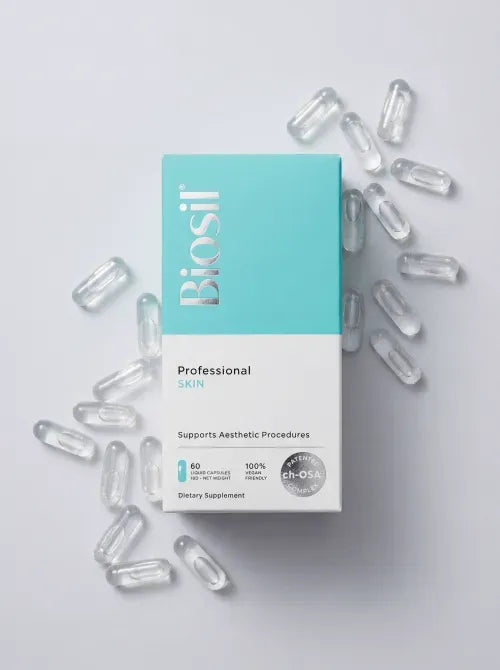
Biosil® exists because a Belgian microbiologist spent the early 1990s trying to keep a molecule from falling apart. Silicon reaches the body in a usable state only as orthosilicic acid, and orthosilicic acid will not stay in solution: concentrate it and it polymerizes into particles nothing can absorb. Solving that stability problem produced ch-OSA® (choline-stabilized orthosilicic acid), and everything since, from the bone research to the skin and hair studies and the dental work now under way, follows from it.
What follows is the history as told by Dr. Mario Calomme, who joined the company at its founding and has led its research ever since. It is a research story, not a claims page: where the evidence stops, we say so.
1990 to 1994: Antwerp, and a molecule that would not stay still
The inventor of ch-OSA® was Professor Vanden Berghe of the University of Antwerp. He was a medical microbiologist, not a supplement formulator, and his interest in silicon was academic: silicon is a trace element, yet an unusually abundant one, and he wanted to study its effect on microbes.
He ran into the same wall everyone else had. Orthosilicic acid is the only form of silicon biology can readily use, but as soon as you try to concentrate it, it polymerizes into gels and larger compounds that not even microbes can take up. So he approached it from the other end: synthesize orthosilicic acid directly, then stabilize it before it could transform.
He screened a great many molecules. One performed markedly better than the rest, and it was interesting in its own right as a nutrient rather than an inert stabilizer: choline. Synthesizing orthosilicic acid in the presence of choline chloride produced a genuinely new complex: choline-stabilized orthosilicic acid.
Mario Calomme was working in that laboratory at the time, on his PhD.
1994: A company founded to industrialize one compound
Vanden Berghe had several product ideas in play, most unrelated to silicon, an antiviral against herpes among them. Through an earlier selenium project, run with companies including Nutricia in the Netherlands and also part of Calomme's doctoral work, he had come to know Geert Wits, who worked in venture capital and specialized in finding companies worth investing in.
The two of them founded Bio Minerals to develop those new products, ch-OSA® among them. They needed someone to do the development work; Calomme had just finished his PhD, and joined. His description of the starting position is not romanticized: "We had really nothing. We had absolutely nothing."
What they did have was access. Wits was also involved with Conforma, a GMP-approved pharmaceutical manufacturer, and Bio Minerals began life in a few offices and a small formulation lab inside it. Within a few years the other programs were abandoned, with toxicity problems in some and manufacturing difficulty in others, and the company narrowed to ch-OSA® alone. Two problems mattered: producing the compound at industrial scale, and establishing whether it did anything.
The bone years: from Edith Carlisle to a rat model
The efficacy work started with bone, because the literature pointed there. In the 1980s the American professor Edith Carlisle had argued that silicon is an essential nutrient, feeding rats a silicon-deficient diet and documenting the consequences: weak bones, abnormal calcium deposition, low bone density and, notably, disturbed collagen metabolism.
Bio Minerals took a different route. Rather than a deficiency diet, the team used an established rat model of postmenopausal osteoporosis, with estrogen-deficient animals against sham-operated controls, placebo, and ch-OSA®. Bone mineral density fell sharply in the estrogen-deficient animals; in the ch-OSA® group, that fall was partially prevented.
A second study looked at collagen directly, in calves on an ordinary diet that already contained a fair amount of silicon. Adding only 5% more as ch-OSA® raised the hydroxyproline content of skin biopsies by more than 12%. Hydroxyproline is a marker of collagen formation. Two signals, then: bone density in deficient animals, and collagen activity in normal, growing ones.
From preclinical to clinical: St Thomas' and Tim Spector
The bone program included a collaboration with a laboratory at the St Thomas' institute, part of the University of London, and that connection led to Tim Spector, a rheumatologist by training, known for his twin studies and at the time focused on osteoporosis. He was interested, and the resulting trial in osteopenic women showed an effect on bone mineral density and on bone collagen formation, confirming in humans what the animal work had suggested.
That study is published (Spector et al., 2008) and should be read with its limits intact: the significant finding was on a marker of bone collagen formation, while the bone-density change was a small, non-significant trend. It was funded by the manufacturer.
The turn nobody planned: skin, then hair
If the compound acted on collagen, skin was the obvious next question. Calomme approached Professor André Barel at the University of Brussels, a well-known name in cosmetic science, who proposed a study in women with photoaged skin. It reported reduced wrinkles and improved elasticity.
Barel's reaction to his own result changed the company's direction. As Calomme tells it, Barel was surprised that one compound could do this across so many tissues, and asked the obvious commercial question: why are you spending all this effort on bone, when you have something here that is far easier to explain to people, and far easier to sell? Bio Minerals moved its weight to skin.
Hair followed. Barel introduced the team to Professor Randy Wickett in the United States, an authority on hair and skin, who served as principal investigator on a study run in Germany. It reported thicker, stronger, more elastic hair.
Both studies are manufacturer-funded, and both measured cosmetic endpoints in healthy volunteers. They are the reason the brand is known for beauty. They are not evidence about a surgical site.
How dentistry found Bio Minerals
Dentistry did not come from a strategy meeting. A dentist connected to the company's shareholders, the orthodontist Kathleen Vamirov, heard about the bone and collagen results, and made a connection nobody inside the company had made: bone and collagen are the substrate of periodontal and peri-implant health too.
She started informally, with colleagues' practices rather than her own, and the first case studies focused on periodontitis. They showed a real effect on pocket depth. Case studies are not trials, but they were enough to justify patent protection, which was filed and has since been granted in several countries.
Leuven said it would be difficult. Turkey said yes.
Moving from case studies to clinical trials was harder. Vamirov approached a former classmate from dental school who had become a professor at the University of Leuven, Wim Teughels, a recognized name in periodontology. His answer was candid: running a food-supplement study at Leuven would be very difficult and very slow, because the institution is conservative about supplements. But he had worked for years with a colleague running a strong clinic in Turkey, and proposed going there instead.
Two studies followed: one in periodontitis and a pilot in peri-implantitis. The periodontitis study randomized 85 patients with severe generalized periodontitis and reported significant effects on both probing pocket depth and bleeding on probing at six months. It was presented at the Greater New York Dental Meeting and has not, to date, been published in an indexed journal. The peri-implantitis pilot was published as Teughels et al., 2021: exploratory, randomized, double-blind and placebo-controlled, but small, and on its own it did not show a difference in pocket depth or bleeding. Its significant findings were mucosal recession and peri-implant bone stability.
The follow-up has been slow for reasons that have nothing to do with the science. Turkish approval now requires importing product, clearance from the Ministry of Health and an ethics committee, and Calomme is blunt that the process is political. The wait ran to two or three years. That study, on the prevention of peri-implantitis, is now under way, alongside work on gingivitis.
Where the research stands today
Bio Minerals frames ch-OSA® as a preventive nutritional tool rather than a treatment, and the implant protocol is the clearest expression of that: begin before surgery, continue afterwards, with the aim of supporting the patient's own bone and collagen nutrition through the period when it matters most.
That is the hypothesis the current trials are designed to test. It is not yet a proven outcome, and it is stated here as a research direction, not a promise.
What we can and cannot say
Thirty years of work does not entitle anyone to overstate the result, and practitioners are right to ask hard questions about randomization, blinding, controls, statistical significance and PubMed indexing.
- ch-OSA® is a food supplement. It is not a drug, and it does not treat, cure, heal or prevent any disease or complication.
- It has not been shown to speed healing, prevent dry socket, improve osseointegration, or reduce surgical complications.
- The strongest human findings are markers of collagen formation, not clinical endpoints.
- The dental evidence consists of case studies plus two randomized trials, one of which is a small exploratory pilot and one of which is a conference presentation rather than an indexed publication. Trials adequately powered for clinical outcomes are ongoing, not finished.
- The great majority of the studies described here were funded by the manufacturer, and we say so on every page that cites them.
Anything ch-OSA® is used for should be discussed with the treating clinician first. It is an adjunct to care, never a substitute for it.
The people behind the compound
-
Professor Vanden Berghe, University of Antwerp. Medical microbiologist, invented the choline-stabilization method.
-
Geert Wits. Co-founder and managing director of Bio Minerals, brought the venture-capital and manufacturing route through Conforma.
-
Dr. Mario Calomme. Joined at founding straight from his PhD, has led research and clinical development since.
-
Professor Edith Carlisle. Established the case for silicon as an essential nutrient, the reason the work began with bone.
-
Professor Tim Spector, St Thomas' and University of London. Principal investigator on the osteopenia trial.
-
Professor André Barel, University of Brussels. Skin study, and the reason the company turned toward beauty science.
-
Professor Randy Wickett. Principal investigator on the hair study.
-
Kathleen Vamirov, orthodontist. Opened the dental line of research and ran the first periodontitis case studies.
-
Professor Wim Teughels, University of Leuven. Brought the dental work into a controlled clinical setting.
Where to go next
Sources
- Spector TD, et al. Choline-stabilized orthosilicic acid supplementation as an adjunct to calcium/vitamin D3 stimulates markers of bone formation in osteopenic females: a randomized, placebo-controlled trial. BMC Musculoskelet Disord. 2008;9:85. View source
- Teughels W, et al. The effect of choline-stabilized orthosilicic acid in patients with peri-implantitis: an exploratory randomized, double-blind, placebo-controlled study. BMC Oral Health. 2021. View source
- Teughels W, Persyn S, Haytac C. The effect of choline-stabilized orthosilicic acid on periodontitis: a randomized, double-blind, placebo controlled study. Presented at the Greater New York Dental Meeting.
- Barel A, et al. Effect of oral intake of choline-stabilized orthosilicic acid on skin, nails and hair in women with photodamaged skin. Arch Dermatol Res. 2005. View source
- Wickett RR, et al. Effect of oral intake of choline-stabilized orthosilicic acid on hair tensile strength and morphology in women with fine hair. Arch Dermatol Res. 2007. View source
- Bio Minerals NV. Choline-silicic acid complex with osmolytes and divalent trace elements (US Patent 7,968,528 B2). View source