Facelift Recovery Time at a Glance
A facelift (rhytidectomy) is real surgery, and the recovery follows a predictable arc. The visible part, the swelling and bruising, is the shortest and most dramatic stretch. The quieter part, tissues settling and the final contour appearing, takes months. Knowing which is which keeps you from panicking on day two and from expecting the finished look on day ten.
This guide walks through the recovery week by week: what is normal, what is not, and the simple habits that protect your result. Your surgeon gives you instructions specific to your case and your technique. Use this as a map, not as a replacement for their advice. For the wider set of procedure timelines, see our aesthetic recovery guides.
Facelift recovery time: the main phases and how long each lasts
| Phase |
Typical timing |
What is happening |
How you feel |
| 1. Early recovery |
0-72 hours |
Swelling and bruising build, dressings and possibly a drain in place |
Tight, sore, tired |
| 2. First week |
Days 3-7 |
Swelling near peak then starting to turn, sutures reviewed |
Puffy, bruised, improving |
| 3. Looking presentable |
Weeks 2-3 |
Most bruising fades, makeup often possible |
Socially comfortable |
| 4. Settling |
Weeks 4-12 |
Residual swelling and numbness resolve slowly |
Near normal |
| 5. Final result |
Months 3-12 |
Scars soften and mature, contour finalizes |
Fully recovered |
The First 24 to 72 Hours
The first three days are the most uncomfortable and the most important for protecting your result. The main risk in this window is a hematoma, a collection of blood under the skin, which is why surgeons watch this phase closely.
What is normal early on
Expect a snug dressing around your face and head, tightness, puffiness, and bruising that builds rather than fades at first. Swelling typically peaks around 48 to 72 hours, so your face can look worse on day two than right after surgery. Mild oozing at incision lines and numbness in front of the ears are common. Discomfort is usually described as tightness and pressure more than sharp pain.
The core early rules
-
Keep your head elevated, including while sleeping, to limit swelling.
-
Use cold compresses as your surgeon directs in the first 24 to 48 hours.
-
Rest and avoid bending, straining, or lifting, which raise pressure in the head and bleeding risk.
-
Do not smoke. Smoking constricts blood flow to the healing skin and is strongly linked to poor healing.
Week 1: The Turning Point
By around day three the swelling stops climbing and begins to settle. Over the rest of the first week you will feel steadily better, though you will still look bruised and puffy.
Dressings, sutures, and drains
Your surgeon usually reviews you within the first week, removes or changes dressings, and checks the incisions. Any small drain is typically removed early. Some sutures dissolve, others are removed around days 5 to 10. Numbness and a tight feeling are expected and improve gradually over weeks.
Activity in week one
Gentle short walks around the house support circulation and are encouraged. Continue to avoid bending over, lifting, and any strenuous activity. Most people are not ready to be out in public yet, and that is normal.
Week 2: Looking Presentable Again
The second week is when life starts to feel normal. Bruising fades from dark to yellow-green and then clears, and much of the obvious swelling has gone down.
Returning to work and social life
Many people with desk-based jobs return to work around two weeks, often with the help of makeup once the surgeon confirms incisions are healed enough. Physically demanding jobs need longer. You may still notice tightness, mild swelling, and numbness, which are normal at this stage.
Weeks 3 to 6: Building Back Up
Through weeks three to six you gradually return to your usual routine. Most surgeons clear light exercise around this point and heavier exercise a little later, because exertion that spikes blood pressure can worsen swelling early on. Continue to protect the incisions from sun and follow your surgeon's scar-care advice.
Months 1 to 12: The Final Result Settles
The finished look is a matter of months, not weeks. Subtle swelling and numbness can persist and resolve slowly over three to six months, sometimes longer near the ears. Scars are placed in natural creases and along the hairline, and they fade and flatten over six to twelve months. Sun protection and not smoking are the two habits that most protect how the scars mature.
Facelift recovery week by week: what you may notice and what to do
| Time |
What you may notice |
What to do |
| Days 1-3 |
Swelling and bruising rising, tightness |
Head elevated, cold compress, rest, no bending or lifting |
| Days 4-7 |
Swelling turning the corner, bruising spreading then fading |
Attend follow-up, gentle short walks, light diet |
| Week 2 |
Bruising clearing, more comfortable |
Many return to desk work, makeup once cleared |
| Weeks 3-6 |
Mild residual swelling and numbness |
Ease back into exercise as your surgeon allows, protect from sun |
| Months 3-12 |
Scars softening, contour finalizing |
Sun protection, scar care, no smoking |
Normal Healing vs Warning Signs
Most of a facelift recovery is uneventful. Knowing the difference between normal healing and a red flag lets you relax through the former and act fast on the latter.
Green flags: you are healing as expected
- Swelling and bruising that peak in the first few days, then decline.
- Tightness and numbness that slowly ease week by week.
- Incisions that stay clean and dry, with no spreading redness.
- Discomfort that is controlled and steadily decreasing.
Red flags: call your surgeon
- Rapidly increasing swelling or pain on one side of the face, especially in the first 24 to 48 hours (a possible hematoma).
- Severe or escalating pain rather than steady improvement.
- Fever, spreading redness, pus, or a foul odor from an incision.
- Skin that turns dark, dusky, or blistered, which can signal a blood-supply problem.
How to Support Your Recovery
You cannot rush wound healing, but you can give your body the best conditions and avoid setting it back. Rest, sleep with your head elevated, stay hydrated, eat well with enough protein, keep the incisions protected from sun, and do not smoke. Attend every follow-up so anything unusual is caught early.
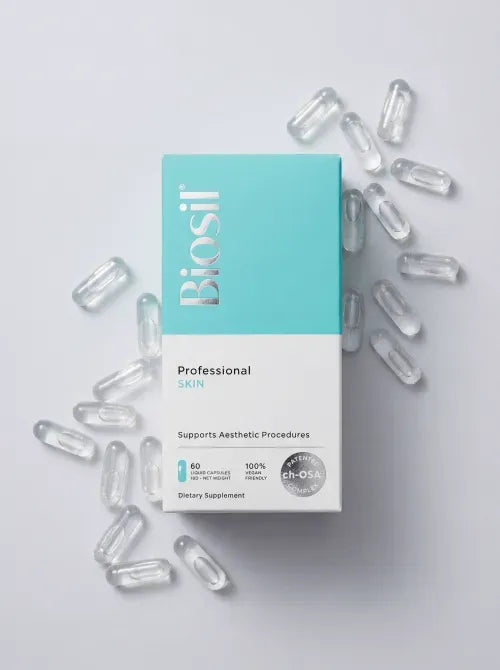
Skin owes its structure and firmness to collagen, the main protein in its deeper layer, and the body rebuilds and remodels collagen throughout healing in general. Supporting your body's normal collagen formation through good overall nutrition is reasonable background care, framed as an adjunct to, never a replacement for, your surgeon's plan. If you want to understand the molecule behind Biosil®, read what ch-OSA® is, and you can review the underlying studies on our peer-reviewed evidence page.
Where ch-OSA® from Biosil® fits: skin and connective tissue are largely collagen, and ch-OSA® provides bioavailable silicon your body uses to make its own collagen. This is general connective-tissue nutrition, an adjunct only. Discuss any supplement with your surgeon.
Recovering from a different procedure? See our guide to tummy tuck recovery time.
What This Guide (and ch-OSA®) Does Not Claim
Honesty matters on a page like this, so here is what we are not saying.
- No supplement, including ch-OSA®, has been shown to speed facelift recovery, reduce swelling or bruising, shorten downtime, or improve your scar or surgical result.
- There is no ch-OSA® study in facelift or any cosmetic-surgery recovery. The collagen science here comes from skin and cell-culture research and is applied by reasoning, not proven for surgery.
- ch-OSA® is general connective-tissue nutrition and an adjunct only. Do not start, stop, or change any supplement before or after surgery without your surgeon's approval, and always follow your surgeon's instructions.
- These statements have not been evaluated by the Food and Drug Administration. This product is not intended to diagnose, treat, cure, or prevent any disease.
Sources
- American Society of Plastic Surgeons. Facelift recovery. View source
- American Society of Plastic Surgeons. Facelift overview. View source
- Barel A, Calomme M, Timchenko A, et al. Effect of oral intake of choline-stabilized orthosilicic acid on skin, nails and hair in women with photodamaged skin (skin study, not surgery). Arch Dermatol Res. 2005;297(4):147-153. View source
- Reffitt DM, et al. Orthosilicic acid stimulates collagen type 1 synthesis and osteoblastic differentiation in human osteoblast-like cells in vitro (cell-culture study, not human, not surgery). Bone. 2003. View source
- Spector TD, et al. Choline-stabilized orthosilicic acid supplementation as an adjunct to calcium/vitamin D3 stimulates markers of bone formation in osteopenic females. BMC Musculoskelet Disord. 2008;9:85. View source